Take a Lesson Before Buying Fly Fishing Gear
Fly fishing is easier to judge after you have felt a fly rod load and watched an instructor correct your timing. Most beginner lessons and courses provide the rod, reel, line, flies, and sometimes waders. Try a lesson first, then buy gear once you know the type of water and fishing you want to do.
Your options range from free and low-cost Learn to Fish programs, to private casting lessons, to guided half-day or full-day trips with instruction built into the day. Ontario Learn to Fish is free. BC Learn to Fish lists $10 per youth participant and no charge for adults. FCC chapters and fly shops may be free or low-cost depending on the event. Many of these sessions teach general fishing basics rather than fly-specific coaching.
You need the right licence or permit when the lesson involves actual fishing. Casting practice on grass does not require a fishing licence because you are not angling. In 2026, check that your licence is current before booking; BC freshwater purchases now use the WILD system and FWID.
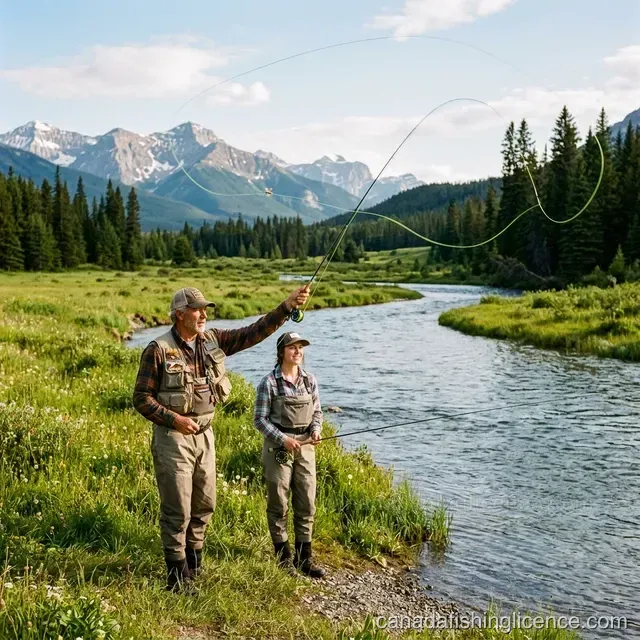
Free & Low-Cost Programs — No Experience Required
Provincial Learn to Fish Programs (free, equipment provided):
• Ontario: The government's Learn to Fish program is a free, 2-hour introduction that teaches rigging, baiting, casting, fish identification, and regulations. The current page says it runs through the summer at various locations. It can pair well with Ontario's 2026 licence-free events if you are an Ontario or Canadian resident.
• BC: The Freshwater Fisheries Society of BC runs Learn to Fish programs for youth and families at locations across the province. The current page lists $10 per youth participant and no charge for adults. Sessions cover when, where, and how to catch fish, with basic gear and instruction supplied by the program. Some participating locations also offer rod loan options.
• Alberta: Provincial parks and Alberta Parks host family fishing events, particularly during Family Fishing Weekends (e.g., Family Day long weekend in February). Equipment typically provided. Check Alberta Parks event calendars.
Freshwater Conservation Canada / Trout Unlimited chapters (free or low-cost events): Trout Unlimited Canada now operates as Freshwater Conservation Canada (FCC). FCC and local chapters run conservation projects, volunteer events, youth programs, and occasional fly fishing or casting sessions. Check your nearest chapter before assuming a clinic is running in a given month.
Fly shop casting clinics (free or low-cost): Dedicated fly shops often run beginner casting clinics in a parking lot, park, pond, or nearby field. The format is usually simple: 1-2 hours of casting instruction, knot tying, and basic fly selection. Search "fly shop near [your city]" and call to ask whether beginner clinics are scheduled this season.
Online resources (free): Video lessons are useful for seeing the motion before you attend a class. The Orvis Fly Fishing Learning Center, Mad River Outfitters, Trident Fly Fishing, and The New Fly Fisher all have beginner-friendly material. Video does not replace feedback from an instructor, but it can make the first in-person lesson less confusing.
Paid Lessons and Guided Instruction: Typical 2026 Cost Ranges
Published guide prices change often, so treat the numbers below as planning ranges and examples to check before booking. Most prices are in Canadian dollars, before tax and gratuity. Many lessons include rods, reels, line, flies, and basic terminal gear; licences are usually separate.
Private casting lesson (1-2 hours): often about $125 per person. Grand River Troutfitters currently publishes $125 for fly casting and fly tying lessons. This is usually on grass, a pond edge, or quiet water and focuses on casting mechanics, mending, and basic fly selection. No fishing licence is normally needed if you are only practicing casting.
Learn-to-fly-fish lesson (3-5 hours): often about $275-$395. Grand River Troutfitters currently publishes $275 for one person and $395 for two people, plus a pond introduction. This format combines casting instruction with actual fishing.
Half-day guided trip (4-6 hours): often about $550-$625 depending on river, boat use, region, and group size. Interior Fly Fishing Co. currently publishes $550 half-day solo and $650 half-day for two or three anglers. Bow River Fly Fishing currently publishes $625 for a half-day or evening Bow River trip.
Full-day guided trip (6-8+ hours): often about $650-$725 for the current examples here. Interior Fly Fishing Co. currently publishes $650 full-day solo, $850 double, and $1000 triple; Bow River Fly Fishing currently publishes $725 for a full-day Bow River trip.
Multi-day schools and lodge packages: often run from the high hundreds into several thousand dollars when accommodation, meals, boats, and multiple fishing days are included. These make more sense after you know you enjoy the sport.
Simple way to reduce cost: book with one friend if the guide allows two anglers for one boat or walk-and-wade rate. Two-person rates are often cheaper per person than a solo trip, and a weekday can be easier to book than a peak summer weekend.
How to Find a Qualified Guide
Guide rules are not the same in every province. Before booking, ask what is included, what licence you need, what water you will fish, and what happens if conditions are poor.
British Columbia: BC freshwater angling guides must hold a provincial angling guide licence. The provincial application path includes age and residency requirements, liability insurance, an Angling Guide Exam, FWID registration in the WILD system, and an Angling Guide Operating Plan. Ask for the guide licence number before you pay a deposit. For tidal saltwater guiding, look for the separate tidal angling guide pathway used in BC.
Alberta: Alberta does not use the same freshwater guide licensing model as BC. For Bow River and other Alberta trips, look for an established business, clear insurance answer, specific water knowledge, recent client feedback, and local fly shop recommendations. Your own Alberta licence and WiN account requirements still apply when you fish.
Ontario: Ontario freshwater fishing guides are not checked through a single province-wide guide licence system. Reputation and local knowledge matter. Ask fly shops on the Grand River, Credit River, and nearby waters who they trust, and look for clear pricing, client expectations, safety practices, and liability insurance.
General warning signs: vague insurance answers, no recent client feedback, prices far below local norms, resistance to discussing catch-and-release practices, and no mention of licence requirements. A careful guide will ask whether you have the right fishing licence before the trip.
Starting resources: Grand River Troutfitters (Ontario). Bow River Fly Fishing (Alberta). Interior Fly Fishing Co. (Kamloops, BC). FishingBooker.com aggregates Canadian guide listings, reviews, and published price ranges.
What to Expect at Your First Lesson
First 30 minutes — Casting on grass or pavement: The basic overhead cast. Fly casting uses the weight of the fly line (not a heavy lure) to carry the fly. The instructor stands behind you and coaches your timing. The key concept: your rod tip moves between the 10 o'clock and 2 o'clock positions. Many beginners can make short, fishable casts by the end of the first practice block.
Next 15 minutes — Knots and rigging: You'll learn 2 essential knots: the clinch knot (tying on flies) and loop-to-loop (connecting leader to fly line). Two knots is enough to start. Don't stress about learning 20 knots — that comes with time. The guide handles any other rigging.
Remainder — Fishing: For on-water lessons, you'll wade into a river or fish from the bank. The guide ties on the right fly, positions you in promising water, tells you where to cast, and coaches you through hooking and landing fish. The guide does the hard part (reading current seams, choosing the pattern, adjusting depth); you practice casting and catching.
What you may catch: Many beginner lessons focus on trout because stocked rainbows, small-stream brook trout, and river brown trout give useful casting and presentation practice. In warmwater areas, panfish, bass, or pike can also be good first fly rod targets. The exact species depends on the province, waterbody, season, and local rules.
What to wear: Layers (mornings on rivers are cold even in summer), polarized sunglasses, a hat with a brim, closed-toe shoes you don't mind getting wet (the guide provides waders for wading lessons). Winter lessons require thermal layers, waterproof boots, and hand warmers.
What not to worry about: A beginner lesson is expected to include tangled line, lost flies, missed casts, and quiet stretches. A guide can improve your chances, but no honest lesson can promise a fish. The useful outcome is leaving with a repeatable cast, a few knots, and a clearer idea of how to approach water.
First Lesson Destinations by Region
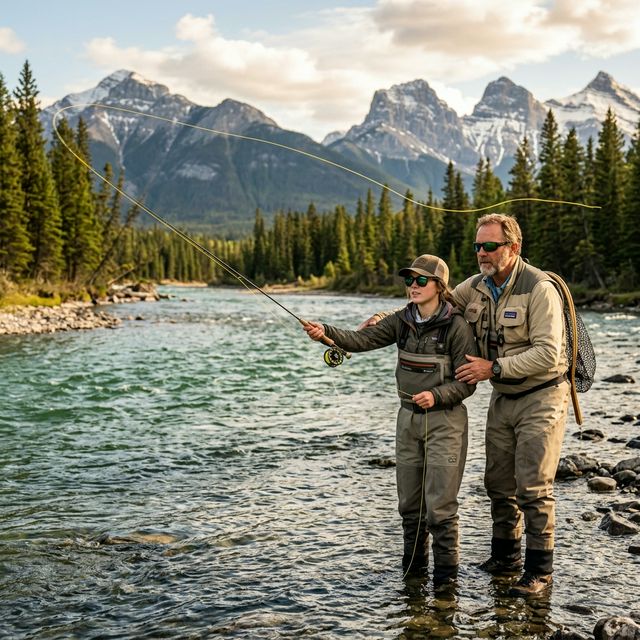
Ontario — Grand River (near Kitchener-Waterloo): A well-known beginner-accessible trout fishery in Ontario. Brown trout and rainbow trout in a gentle, wadeable river. Grand River Troutfitters currently publishes $125 casting lessons, $275/$395 learn-to-fly-fish lessons, and $275-$650 guided trips. One hour from Toronto. The tailwater section below Shand Dam produces year-round. Grand River Troutfitters publishes updated 2026 pricing.
British Columbia — Kamloops Interior Lakes: A major Canadian stillwater fly-fishing region. Dozens of stocked rainbow trout lakes have easy road access. Kamloops trout often respond well to chironomid and leech patterns. Interior Fly Fishing Co. currently publishes $550 half-day solo, $650 half-day for two or three anglers, and $650 full-day solo rates. Use GoFishBC to find stocked lakes near you.
Alberta — Bow River (Calgary/Banff): Well-known trout water with guides at every experience level. The Bow through Calgary has strong trout density in some stretches. Bow River Fly Fishing currently publishes $625 for a half-day or evening trip and $725 for a full-day trip. Year-round fishery, with winter nymphing below dams as a common cold-season option. Further upstream in Banff National Park, park waters use the separate Parks Canada permit path, and Banff applies its own fishing rules. Check the current Banff page before you add park water to the lesson plan.
Quebec — Eastern Townships: Small streams and lakes can suit short-cast learning, especially for brook trout (omble de fontaine) where the season and local access allow. French and English instruction may both be available, but check the zone, access rules, and outfitter details before booking.
New Brunswick — Miramichi River: Well-known Atlantic salmon water with a long tradition of fly fishing instruction. For Atlantic salmon on Crown waters, non-residents usually book a licensed guide or stay within another legal path. Lodge packages typically include guiding.
Can't travel? Search "fly fishing lessons [your city]" and call the nearest fly shop, conservation authority, or stocked-lake program. Stocked lakes near cities are often a practical learning option because access is simpler and casting distances are short.
After Your Lesson — Smart Starter Gear Guide
If the lesson goes well, keep the first setup simple and match it to local water:
Buy: a complete 5-weight outfit ($150-$350). Rod, reel, line, and backing come matched and balanced. A 5-weight is a common freshwater starting point for trout, bass, and panfish, though pike, salmon, steelhead, and heavy wind may call for a different rod.
Buy: a small fly box with local patterns ($30-$60). Ask the fly shop to fill it for the water you actually plan to fish. For trout, that may include woolly buggers, elk hair caddis, pheasant tail nymphs, hare's ear nymphs, and a few general dry flies in local sizes.
Buy: a spool of tippet ($5-$10). Tippet replaces the fine end of your leader after break-offs and fly changes. Ask the shop which size fits your local target species.
Wait on waders ($200-$500). You can learn a lot from the bank, a dock, or shallow wet-wading water before buying waders. Buy them after you know whether you mostly fish rivers, lakes, cold water, or warm summer shorelines.
Wait on a float tube or pontoon boat ($200-$600). Bank fishing teaches enough for a first season, and local water access rules may affect whether personal watercraft are useful.
Wait on high-end gear. A more expensive rod may feel nicer, but it will not fix timing, line control, or water reading. Spend first on a lesson, local flies, sunglasses, and time on easy water.
Total beginner gear cost: $190–$420. A practical starter setup for a first season of productive fly fishing. That's less than one full-day guided trip.
Season Planning — When to Book Your Lesson
May-June: This is a strong beginner window in many trout regions because water is usually cooler, insects are active, and weather is easier to handle than deep winter or late-summer heat. Book early for popular rivers and guide calendars.
September-October: Fall can be comfortable and productive, with fewer crowds in some places. Check species seasons before assuming a waterbody is open, especially where trout, salmon, or special waters have narrower dates.
July-August: Hot weather can slow trout fishing on low-elevation rivers and raise catch-and-release stress. Early morning, evening, lakes, higher-elevation water, or warmwater species may be better lesson choices.
November-March: Winter fly fishing is possible where open-water seasons allow it, especially on some tailwaters and rivers that remain ice-free. It is a colder, more specialized lesson choice, not the easiest first outing for most beginners.
Booking timeline: Free provincial programs often post schedules in late spring or summer. Guided trips may need 2-4 weeks of lead time for weekdays and longer for peak weekends. Multi-day schools and lodge programs can fill months ahead.