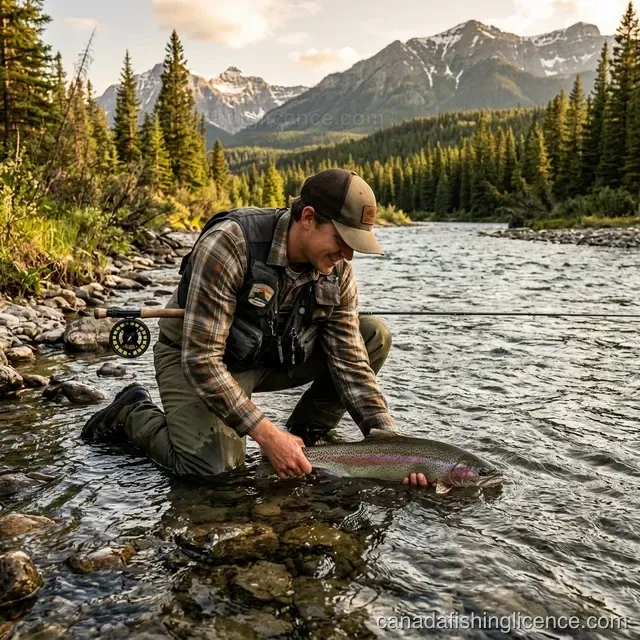
Catch and Release Rules Canada 2026: Zero Limits, Barbless Hooks and Closed Seasons
Check when catch-and-release is allowed in Canada, including closed seasons, zero limits, release-only waters, barbless hooks, warm-water notices and safe handling.
Updated August 16, 2026
Catch-and-release is only allowed when the exact water, species, season, and gear rules allow it. A closed season stays closed even if every fish goes back. Check the local rule first, then keep handling fast, wet, and careful.
Catch And Release Is Usually A Water-Specific Rule, Not A General Style Choice
In Canada, catch-and-release is not one national rule. It usually shows up in one of four ways: a species has a zero possession limit, a waterbody or park uses a catch-and-release only rule, the season is open but the retention limit is zero, or a mid-season notice temporarily changes what anglers may keep.
That is why the clean way to plan a catch-and-release trip is simple: start with the exact water, read the current rule summary for that water, then rig your tackle and handling setup to match those rules.
If you only remember one thing, make it this: a fish that must be released is still a regulated fish. The rule is not finished when the fish reaches the net. Hook type, bait rules, how long the fish stays out of water, and whether a same-day notice is in effect can all matter just as much as the retention limit itself.
Choose The Catch-And-Release Rule First
The safest next step depends on why you are releasing the fish. A zero limit, a closed season, a barbless-hook rule, a park permit, and a warm-water notice are different problems, even when the practical plan is to let every fish go.
Zero limit
Check the exact water and species
Release-only, zero possession, and zero retention rules still depend on the local entry.
Closed season
Do not target the fish
A release plan does not make a closed season open.
Gear or handling
Match the tackle rule
Barbless hooks, bait bans, pliers, nets, and quick handling can matter as much as the limit.
Park or salmon water
Check the separate system
National parks, salmon waters, and warm-water notices can change the ordinary provincial answer.
Question or situation
Short answer
What to check next
Catch-and-release only, zero possession, or zero retention
Check the exact water, species, and handling rule before you fish.
Once the rule type is clear, come back to the handling basics below. The goal is not only to release the fish, but to do it under the right season, licence, permit, gear, and notice conditions.
How Catch And Release Usually Appears In Canadian Rules
Different provinces and federal systems express catch-and-release in different ways. The wording changes, but the practical meaning is usually easy to read once you know what to look for.
Rule format
What it means at the water
Typical official wording
Zero possession or zero catch-and-keep limit
You may be allowed to angle for the species, but every fish must go back immediately.
"0", "zero possession", or "catch and release only".
Waterbody-specific catch-and-release rule
The named lake, river, or river section can be stricter than the surrounding zone.
Special regulations in the waterbody table or park brochure.
Species-at-risk or native-species protection
The fish must be released, and in some places you may need to release it immediately if you are unsure of the species.
"If you catch this fish you must release it" or "if unsure, release immediately".
Warm-water or emergency notice
A fishery that is normally open can temporarily tighten or close because released fish are less likely to survive.
Warm water protocol, fishery notice, or in-season closure notice.
Separate park system
The permit path and release rules are set by Parks Canada, not by the surrounding province.
National park fishing permit and park-specific catch limits.
Ontario's general regulations are a good example of the zero-limit format. The province says that when there is an open season but the limit is zero, anglers may target the species, but any fish caught must be released immediately in accordance with the rules for delaying the release of a fish.
The Five Checks To Make Before You Fish
A catch-and-release trip is easier to keep legal when you make the same five checks every time:
1. Is the season actually open? A catch-and-release opportunity only exists if the season is open. Ontario's general regulations make this explicit: it is against the law to target a species when the season is closed.
2. What is the retention number? Look for zero possession limits, zero catch-and-keep limits, special size windows, or park tables that set "all other species and locations" to zero.
3. What does the tackle rule say? Barbless-hook, single-hook, bait-ban, and one-line rules are often the real catch-and-release rule in practice because they control how safely a fish can be released.
4. Is there a second system involved? National parks, park reserves, and some special fisheries use a separate permit path and their own release rules.
5. Is there an in-season notice today? Warm-water protocols and temporary closure notices can override what the annual summary seemed to allow when you checked it a month earlier.
Examples That Show How Rules Vary
A few official examples show why a general national answer is never enough on its own.
Ontario: the Ontario Fishing Regulations Summary says that if a fish is caught after reaching the daily catch or possession limit for that species, it must be released immediately. The same summary also explains that catch-and-release seasons are legal only where the season is open and the limit is zero.
Manitoba: anglers must use barbless hooks. Hooks attached to all your lines, whether in use or not, must be barbless. That province-wide rule changes catch-and-release handling before you even choose a lake.
Alberta: Alberta's general regulations list 0 bull trout in the provincewide maximum possession table. Alberta's identification guidance also says bull trout have a zero possession limit across the province and must be released if caught.
Atlantic salmon in the Gulf Region: Fisheries and Oceans Canada says recreational fishing for Atlantic salmon in the Gulf Region has been mandatory catch and release since 2015. DFO also runs a warm water protocol on rivers including the Miramichi, Restigouche, Nepisiguit, and Margaree, where restrictions or closures can follow when water temperatures are too warm.
National parks: Parks Canada pages for places such as Banff, Jasper, Fundy, and Kouchibouguac show a different permit and rule structure again. Provincial licences do not apply there, and some park waters are zero possession or catch-and-release only even when nearby provincial waters are not.
What Official Fish-Handling Guidance Says To Do
Ontario's catch-and-release handling page and Parks Canada's mountain-park fishing pages line up on the core handling advice. The message is straightforward: released fish survive better when they are landed quickly, handled less, and kept wet.
Official recommendation
Why it matters
Use tackle appropriate for the species and land the fish quickly
Ontario says quick retrieval helps reduce exhaustion and stress.
Use barbless hooks or flatten the barb
Ontario and Parks Canada both point anglers to barbless or easier-to-remove hook setups.
Keep the fish in the water as much as possible
Parks Canada says fish should stay in the water during handling, photos, and release whenever possible.
Use wet hands and keep fingers away from the gills
Ontario and Parks Canada both warn against squeezing fish or touching gills and eyes.
Use long-nose pliers and remove the hook gently
This shortens handling time and reduces tearing.
Cut the line if the fish is deeply hooked
Ontario says deeply hooked fish should be released quickly with the line cut rather than being forced open.
Support heavy fish horizontally
Ontario warns against holding heavy fish by the jaw because it can injure the jaw and spine.
Banff's current fishing page adds one practical phrase that belongs in every angler's routine: if you are unsure, release it. That advice is especially important where native species have zero possession limits and species can be confused in the net.
Warm Water, Species ID, And Same-Day Notices Matter More Than Many Anglers Expect
DFO's Gulf Region warm water pages explain the reason clearly: Atlantic salmon are cold-water fish, and when water warms up they become weaker and recover poorly after being caught and released. That is why a river can move from open to restricted or closed under a warm water protocol without waiting for the next annual guide.
Species identification matters just as much. Banff and Jasper both say anglers are responsible for distinguishing one species from another, and both pages tell anglers to release the fish immediately if they are not sure what it is. In waters where native species carry zero possession limits, a fast and cautious release is often the safest legal choice as well as the safest biological one.
For practical trip planning, this means you should check the annual summary before you travel, but also look once more at the current notice page or park page on the day you fish. Catch-and-release rules are one of the places where "good enough last week" is not always good enough today.
A Simple Catch-And-Release Kit That Actually Helps
A responsible catch-and-release setup does not have to be complicated, but it should be deliberate.
Long-nose pliers or forceps: Ontario and Parks Canada both mention quick, gentle hook removal.
Barb-crimping pliers: especially useful in Manitoba, parks, and any water where single-barbless or barbless hooks are required or simply the safer choice.
Line cutters: so you can cut the line cleanly on a deeply hooked fish instead of tearing tissue while trying to save the hook.
A knotless or rubber landing net: Ontario recommends soft, knotless rubber when a net is needed.
A quick camera plan: have the phone ready before the fish comes up, or skip the photo and release first.
A thermometer for summer salmonid trips: especially useful on rivers that publish warm-water notices.
That kit is more valuable than carrying a long list of generic "conservation" accessories you never use. The real goal is to reduce fight time, air exposure, and rough handling once the fish is landed.
Does catch and release mean the season is automatically open?
No. A species may only be targeted on a catch-and-release basis if the season is open and the local rule allows release fishing. Ontario's general regulations say it is against the law to target a species when the season is closed.
What does a zero limit mean?
A zero retention or zero possession limit means you cannot keep any fish of that species in that fishery. In an open catch-and-release season, any fish caught must be released immediately according to the applicable rules.
Are barbless hooks required everywhere in Canada?
No. Barbless-hook rules vary by province, waterbody, and park. Manitoba is the clearest province-wide example, while many other places use barbless requirements only on named waters or under special rules.
What should I do if a fish is deeply hooked?
Ontario's catch-and-release handling guidance says to cut the line and release the fish quickly rather than force the hook out of the throat or gills.
Do provincial catch-and-release rules apply inside national parks?
Not automatically. National parks use Parks Canada fishing permits and park-specific rules. Provincial licences do not apply there.
Why do warm-water notices matter even if I plan to release everything?
DFO's warm water protocol pages explain that released fish can recover poorly when water temperatures are too warm. That is why temporary restrictions and closures can apply even in fisheries that are otherwise release-only.
If I am not sure what species I caught, what is the safest choice?
Release it immediately and carefully. Parks Canada pages for Banff and Jasper both tell anglers to release fish if they are unsure of the species.
Share the province, water type, and trip length if you know them. If you are still unsure, send the basic details and I will point you toward the next official check for that trip.
Thank you
Your message has been sent. I will read it and reply when a response is needed.
Optional analytics cookies help improve this site. See our
Privacy Policy.