What Do I Actually Need?
For your first trip, you need 5 things: a rod-and-reel combo ($60–$80), a pack of hooks and sinkers ($15), a bobber, worms from the gas station ($4), and the right provincial licence path for your trip ($10–$42). Total: under $120. That's it. You can catch fish with this setup for years.
Everything else here is secondary. You do not need $500 worth of gear before your first cast. Start with a simple setup, figure out what kind of fishing you enjoy, then upgrade the specific pieces that actually help.
Before You Pack: Licence and Regulations
Before packing any gear, confirm the right official licence portal and have your licence ready, unless an age exemption applies. Most provinces exempt children under 16, while Ontario and Quebec use under-18 youth rules. Keep proof on your phone or printed because conservation officers can ask to see it.
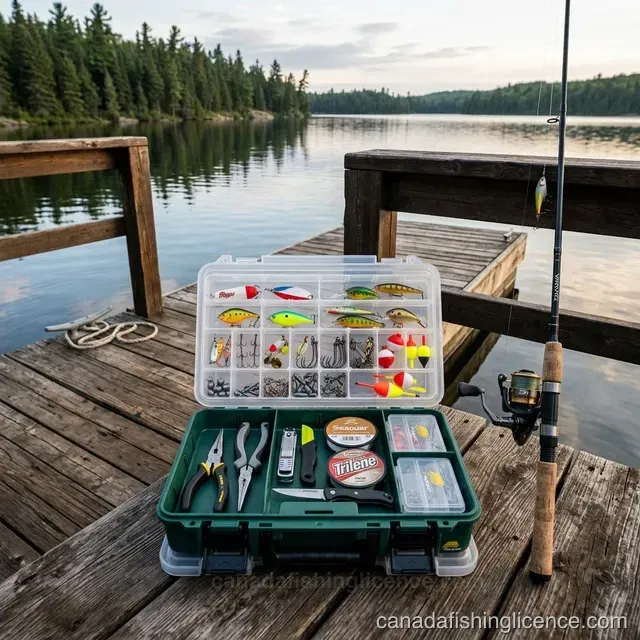
Three regulation checks affect your gear list: 1) Are barbless hooks required? They are mandatory in Manitoba, many BC waters, some Alberta trout waters, and some national park waters. 2) Is lead tackle restricted? Some national parks and provincial waters limit lead tackle, so tin, tungsten, bismuth, or steel sinkers are safer to pack. 3) Is live bait allowed? Alberta prohibits live bait fish and live crayfish, and other waters can add their own bait restrictions. These rules decide what belongs in the tackle box.
Rod, Reel, and Line — The Foundation
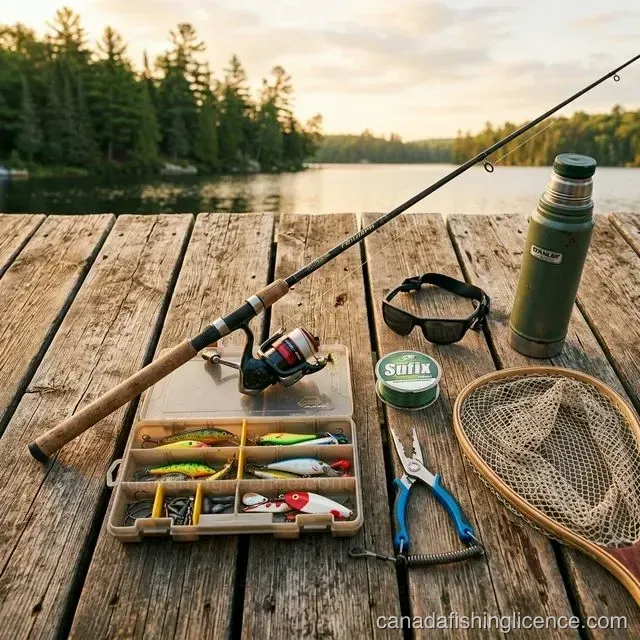
The one setup that covers the most water: A medium-action spinning rod (6'6"–7') paired with a size 2500–3000 spinning reel. This handles panfish, trout, walleye, bass, and small pike. Beginner combos usually run $60–$120 at Canadian Tire, Bass Pro Shops, Cabela's, and local tackle shops.
Line: Spool with 8–10 lb monofilament. It is forgiving, easy to tie knots with, and costs about $8–$12 per spool. For pike or muskie in weedy waters, 20–30 lb braided line with a fluorocarbon or wire leader can make sense, but monofilament is the better first line for most beginners.
When to upgrade: Once you know what you like, add specialized rods: an ultralight (4'6"–5'6") for trout and panfish, a medium-heavy rod for pike and walleye jigging, or a fly rod if river fishing becomes the focus.
Terminal Tackle — Hooks, Sinkers, and Hardware
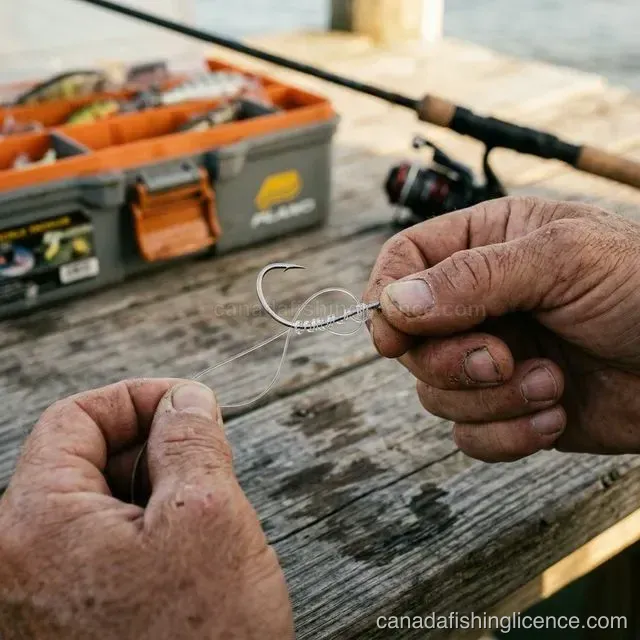
Hooks: Variety is key — sizes 8–10 for panfish, sizes 4–2 for walleye, sizes 1/0–3/0 for pike and bass. Bring pliers for crimping barbs if you're fishing C&R waters or national parks. Circle hooks (size 2–2/0) are excellent for bait fishing — they hook in the corner of the mouth, so fewer gut-hooked fish.
Sinkers: Split shot (BB to 3/8 oz) covers 90% of situations. Bell or egg sinkers (1/4–1 oz) for bottom fishing. Use non-lead alternatives (tin, tungsten, bismuth, steel) in national parks and lead-restricted waters — they cost a bit more but work identically.
The rest of the tackle box: Snap swivels (size 7–10), bobbers/floats (slip floats for deeper water, fixed for shallow), a handful of jigs (1/8–3/8 oz in white, chartreuse, and black), 2–3 inline spinners (Mepps or Blue Fox, sizes 2–4), and 2–3 spoons. The Len Thompson Five of Diamonds is a Canadian classic that catches everything — if you only buy one spoon, buy that one.
Landing and Fish Handling Gear
Landing net: Get a rubber mesh net — it's gentler on fish (protects the slime coat for C&R), and hooks pop out of rubber way easier than nylon. Telescoping handle nets ($25–$45) are great for shore fishing. This is one piece of gear worth buying decent quality — a $15 nylon net fights you every time you need it.
Pliers: Long-nose fishing pliers ($12–$20) are arguably the most important tool after your rod and reel. You'll use them constantly — removing hooks, crimping barbs, cutting line. Add hemostats or forceps for deeply embedded hooks, and a small line cutter or scissors.
Fish measurement: A bump board or ruler ($5–$10) for measuring fish — many species have minimum and maximum size limits. Keep one in your tackle box so you're never guessing. Tackle storage: A basic Plano-style tackle box with adjustable dividers ($15–$30). If you're hiking to remote spots, a small tackle backpack or chest pack keeps hands free.
Clothing and Personal Gear
Layer up — always. Canadian weather changes fast, even in July. Pack: a moisture-wicking base layer, an insulated mid-layer (fleece or merino), and a waterproof outer shell. A rain jacket that lives in your fishing bag saves a lot of miserable drives home. A buff/neck gaiter handles sun and bugs.
Polarized sunglasses ($20–$80): They cut glare so you can see fish and underwater structure, and they protect your eyes from wind, hooks, and glare. Amber or copper lenses are useful on cloudy days; grey lenses are better in bright sun.
Sun and bugs: Waterproof sunscreen (SPF 30+). Insect repellent with DEET or icaridin helps during blackfly and mosquito season, especially near water in Ontario, Manitoba, and Quebec. Add a broad-brimmed hat. Footwear: Waterproof boots or wading sandals with good grip on wet rocks. For river fishing, chest or hip waders open more water.
Safety Equipment
On the water: Carry a properly sized, Transport Canada-approved lifejacket or PFD for each person on a boat, canoe, or kayak. Even from shore, a whistle and basic first aid kit are worth packing. In remote areas, a satellite communicator or personal locator beacon (PLB) is sensible because cell service is unreliable in much of Canada's fishing country. See the boat fishing guide for fuller boating context.
For ice fishing: Add ice picks or claws for self-rescue, a throw rope, and a whistle. Test ice thickness at multiple points and be more conservative when the ice is white, slushy, moving, or recently thawed. Common safety guidance treats about 10 cm (4") of clear blue ice as a minimum walking benchmark for one person, not a guarantee that every lake is safe. Carry dry clothes in a waterproof bag when the weather is severe.
In bear country (BC, Alberta, northern Ontario, Yukon, NWT): Carry bear spray where it is appropriate and practise with an inert trainer before relying on it. Make noise along streams and lake shores, store food and fish properly, and do not leave a catch unattended on the bank. See the national parks guide for park-specific safety context.
Ice Fishing Gear Additions
Ice fishing requires its own kit: an ice auger (hand-powered $40–$80 for beginners, power auger $200–$500 for regulars), short ice fishing rods (24–36", $20–$50 each), small ice jigs and spoons, an ice skimmer ($8–$15) to keep holes clear, and a portable pop-up shelter ($100–$300).
A sled ($30–$60) is essential — you're not carrying all this gear across a frozen lake by hand. Pack extra warm layers, hand/toe warmers, a thermos of something hot, and high-calorie snacks. A portable sonar/flasher unit ($200–$600) shows you fish in real-time under your hole — it's one of the best ice fishing investments once you're committed.
Line allowances vary by province: Many provinces allow more than one line through the ice, including Manitoba, which allows two rods or lines while ice fishing if they stay within 50 metres of the angler. Ontario, Alberta, Saskatchewan, and Quebec also need province- and zone-specific checks. Bring only the number of rods the current rule allows for the water you are fishing.
Budget Starter Kit — Under $200 CAD
You don't need to spend a fortune. Here's a complete beginner kit with real 2026 pricing:
The essentials ($150–$200): Spinning rod-and-reel combo ($60–$80) • 8 lb monofilament line ($8–$12) • Basic tackle kit — hooks, sinkers, bobbers, swivels ($15–$20) • Starter lure pack — spinners, jigs, spoons ($15–$25) • Long-nose pliers ($12–$15) • Rubber mesh landing net ($25–$35) • Small tackle box ($10–$15) • Provincial fishing licence ($10–$42 depending on province).
Where to buy: Canadian Tire has the widest in-store selection at beginner-friendly prices (their Mastercraft brand is decent). Bass Pro Shops and Cabela's for higher-end gear. Walmart for the absolute cheapest tackle. But honestly? Visit a local bait shop first. They sell curated starter kits ($30–$50) with tackle matched to local species, and the staff will tell you exactly where to go and what to use. That advice alone is worth the trip.