| Check | Why it matters in winter |
|---|---|
| Line allowance | Several provinces allow more than one line through the ice, but the distance and supervision rules are different. |
| Shelter rules | Ice huts and long-stay shelters may need registration, outside identification, or removal by a fixed date. |
| Bait and hook rules | Some provinces ban live fish bait, some require barbless hooks, and some waters add their own winter tackle rules. |
| Licence year timing | A January trip can fall into a new licence year in one province but not in another. |
| Special waters | National parks, tidal waters, and some controlled fisheries use a separate permit path even in winter. |
Usually No Special Ice Fishing Licence
Most Canadian provinces do not sell a separate ice fishing licence. The normal recreational fishing licence usually covers both open-water fishing and hardwater fishing during the period when that licence is valid.
The winter part is not a second licence. It is the extra rule layer around the same licence: how many lines you may use through the ice, whether shelters need to be marked or removed by a set date, whether bait rules tighten on that water, and whether the water sits inside a park or another special fishery.
That is why the clean planning order is: pick the exact water first, buy the correct base licence or permit for that system, then read the winter-specific rules for that waterbody and province. That order matters much more than looking for a standalone “ice licence” product that often does not exist.
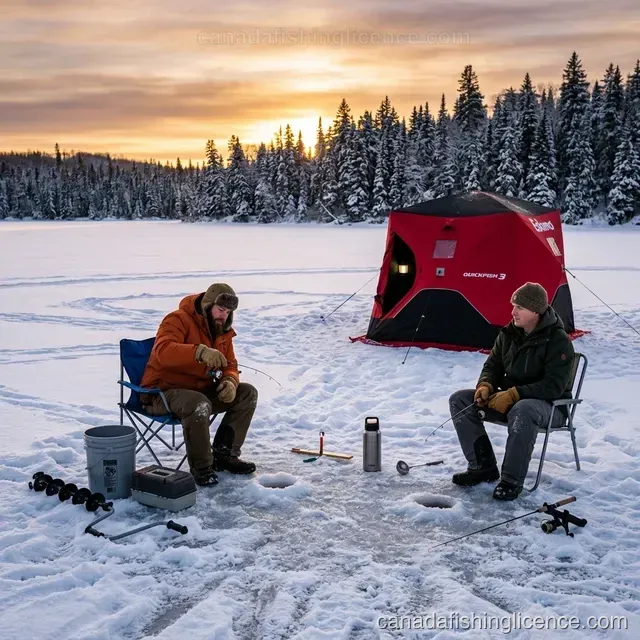
What Actually Changes In Winter
Winter fishing usually changes five things, and these are the checks that matter most before a trip:
If you build the trip around those five checks, most winter licence problems become easier to avoid.
Confirmed Winter Rules That Change Trip Planning Fastest
These are the winter rules that most often change how the day is planned:
| Province | Winter rule to know | What that means on the ice |
|---|---|---|
| Ontario | Two lines are allowed through the ice if you stay within 60 metres of every line or tip-up. | A spread-out setup can become illegal quickly if you walk too far from it or lose sight of it. |
| Alberta | You may not use more than two lines in ice-covered water, you must stay within 30 metres, and a line may not carry more than three hooks. | Alberta rewards simple two-line setups and punishes overbuilt tip-up spreads. |
| Manitoba | Manitoba allows two lines while ice fishing if you stay within 50 metres, requires barbless hooks, and says live bait fish shall not be imported into Manitoba. | Visitors need to check tackle before travel, not only once they arrive at the lake. |
| Saskatchewan | Saskatchewan allows two lines in ice-covered waters if they stay within 25 metres and remain visible at all times. Beginning with the 2026-27 season, many anglers also need an Fisheries Habitat Certificate. | The winter setup and the checkout total both need a second look before you travel. |
| Quebec | Quebec winter rules stay highly water-specific, especially on designated ice fisheries and salmon waters. | Treat the zone or river page as part of the trip plan, not as optional reading after you arrive. |
This table is useful as a trip-planning shortcut, but it still works best when you match it to the exact lake, river, park, or management zone you plan to fish.
Ontario Is The Province Where Ice-Hut Details Matter Most
Ontario’s dedicated ice-fishing page gives the clearest example of how winter rules go beyond the base licence. The province says you may fish with two lines through the ice if you stay within 60 metres of every line or tip-up. The same page also points anglers to hut registration and removal rules.
Ontario says you must register ice huts in FMZs 9 to 12 and 14 to 20 if the hut is non-fabric, or if it is a fabric hut that is 7 square metres (75 square feet) or larger. Smaller portable shelters are treated differently, which is why pop-up tent users should not assume the same rule applies to every setup. The ice hut checker can help you sort registration, identification, and removal questions by province.
Ontario also groups hut-removal deadlines into three winter bands: March 1, March 15, and March 31, depending on the zone where the hut is located. That detail matters because hut-removal dates are a property and safety rule, not a signal that fishing has ended everywhere on that date.
The Prairie Provinces Change The Tackle And Shelter Checklist
Alberta, Manitoba, and Saskatchewan all reward a more disciplined winter setup, but they do it in different ways.
Alberta: the general regulations say anglers may not use more than two lines in ice-covered water, may not be farther than 30 metres from any line, and may not use a line equipped with more than three hooks. Alberta also says ice fishing shelters left on the ice for more than 24 hours must be marked on the outside with a WiN number or with name and phone number in block letters at least 2.5 cm high. Removal deadlines are March 15 in PP1 and March 31 everywhere else, unless an officer directs otherwise.
Manitoba: the current annual angling licence is valid from May 1, 2026 to April 30, 2027. That timing often helps with late-winter planning, but Manitoba also keeps three winter rules that visitors regularly miss: barbless hooks, the two-line rule within 50 metres, and the ban on importing live bait fish into the province.
Saskatchewan: the extra winter check is not only about tackle. For the 2026-27 cycle, Saskatchewan added the Fisheries Habitat Certificate on top of many licence purchases. On the ice, anglers also need to keep both lines within 25 metres and visible, and shelters left out on the lake need outside identification. Saskatchewan is a good example of why licence planning and on-ice compliance should be treated as the same job, not two separate ones.
Bait, Hooks, And Tip-Ups Need More Attention Than The Base Licence
A lot of winter problems are not licence mistakes in the narrow sense. They are tackle mistakes that happen after the licence has already been bought.
Alberta says you may not use live fish for bait, and the regulations also prohibit possession of live bait fish. That pushes many Alberta ice trips toward dead bait or artificial presentations depending on the water-specific rules.
Manitoba keeps the province-wide barbless rule in place through winter. If you are carrying jigs, spoons, deadsticks, and tip-ups, every hook in the working setup needs the same attention.
Ontario and Quebec both require more water-specific reading because bait rules and winter exceptions can change by management zone, fishery, or river system. This is one reason general “Canada ice fishing rules” summaries only get you part of the way.
National Parks Use A Different Permit Path
National park waters are their own planning branch. Parks Canada says a national park fishing permit is required when angling in national parks in Canada, and it also says provincial fishing licences are not valid there.
Parks Canada also says anglers under 16 do not need their own permit if they are accompanied by a permit holder aged 16 or older, but the catch counts toward that permit holder’s daily limit. In Banff, the park page also says felt-soled boots are not permitted in any water body and notes that there is no ice fishing on the Bow River inside the park boundary.
That means a mixed Alberta or British Columbia trip can easily involve two rule systems on the same weekend. If one day is in a provincial reservoir and the next day is inside a national park, buy and carry the correct document for each place instead of assuming one licence will follow you across the boundary.
A Practical Order For Planning A Winter Trip
For the shortest route to a clean winter setup, follow this order:
| Step | What to settle before the trip |
|---|---|
| 1 | Name the exact waterbody, park, or management zone. |
| 2 | Match that water to the correct base licence or permit system. |
| 3 | Read the winter line, hut, bait, and hook rules for that place. |
| 4 | Check whether the licence year turns over before your trip date. |
| 5 | Save the licence or permit where you can show it without mobile service. |
That workflow is simple, but it is still the best defence against winter trips that look organized at checkout and then break down at the access point or on the ice.
If You Are Visiting From Outside Canada
For non-residents and U.S. visitors, winter trips usually get easier when you reduce them to two separate questions: which licence class applies to me and what winter rule is easiest to miss in that province.
In Ontario, that often means matching the trip to the correct non-resident licence duration and reading the hut and line rules for the lake or zone. In Manitoba, it usually means checking barbless hooks and the live-bait import rule before you cross the border. In Saskatchewan, it means remembering that the 2026-27 checkout cost may include the new habitat certificate as well as the licence itself.
If this is your first winter trip into Canada, the simplest option is often to choose one province, one lake system, and one licence system for the whole weekend rather than trying to combine provincial waters, park waters, or tidal waters on the same short trip.