| Before you leave | Beginner check |
|---|---|
| Licence or permit | Buy or confirm the provincial or territorial licence, and check age, residency, free-fishing, and national park exceptions before relying on one. |
| Ice | Confirm current local ice conditions and check thickness as you move; no ice is risk-free. |
| Rules | Check species, season, bait, line, and shelter rules for the exact lake or zone. |
| Gear | Rod, legal local bait or lures, auger or chisel, skimmer, bucket or chair, ice picks, warm layers, spare socks, food, water, and a charged phone. |
| First-hour expectation | Set up simply, fish one or two legal lines, try a few depths, and treat a slow start as normal. |
Start With the Licence, Ice, and Local Rule Check
A first ice fishing trip can be simple, but it should not start with the rod. Start with three checks: whether you have the right licence or permit, whether current ice conditions are suitable, and whether the lake is open for the species you plan to catch.
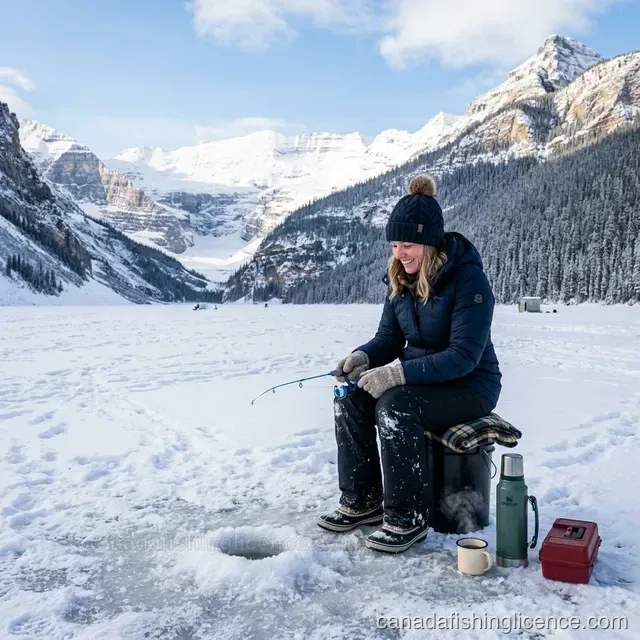
A beginner day often looks like this: drive to a known winter access point, park, walk out only after checking local ice conditions, drill or chisel a hole, drop a line, sit with a hot drink, and watch the rod tip. The fishing is usually quiet and slow between bites. Staying warm, staying within the rules, and leaving before the weather turns are the main skills on the first day.
One thing to note upfront: most adults need the regular provincial or territorial fishing licence to ice fish unless an age, residency, free-fishing, or other exemption applies. National parks use the Parks Canada permit path instead of the provincial licence. There is normally no separate “ice fishing licence”; winter-specific rules are layered on top. See the ice fishing licence guide for province-by-province details.
The Night Before — What to Prepare
Check the ice conditions. This is the first safety step. Call the local tackle shop, hut operator, conservation office, or another local source near the lake. Ice thickness changes across the same waterbody, especially near current, pressure cracks, old holes, snow cover, shorelines, and river mouths.
Ice thickness guidance: Treat thickness numbers as risk guidance, not a guarantee. Alberta says never walk on ice under 10 cm (4 inches) thick and never drive on ice under 30 cm (12 inches) thick. Ontario's Learn to Fish guidance says 15 cm (6 inches) is needed before walking or skating alone, while Ontario's ice fishing page says snowmobiles need at least 20 cm (8 inches) of clear blue ice and light vehicles need 30 cm (12 inches) or more. Clear blue ice is strongest; white or opaque ice is weaker, so Ontario says to double the thickness if the ice is white or opaque. When in doubt, stay off the ice.
| Ice safety check | What to do |
|---|---|
| Go with someone | For a first trip, go with an experienced angler, outfitter, or friend instead of going alone. |
| Tell someone | Share the lake, access point, and return time before you leave. |
| Check as you move | Use a spud bar or auger and avoid assuming one drilled hole represents the whole lake. |
| Avoid weak areas | Stay away from inlets, outlets, flowing water, pressure cracks, old holes, bridges, and aerators. |
| Carry self-rescue gear | Wear ice picks around your neck and keep a phone dry and reachable. |
Dress in layers — not in one big jacket. The common beginner mistake is wearing one heavy coat over ordinary clothes. You can sweat walking out, then get cold while sitting. Instead: thermal base layer, fleece or wool mid layer, and windproof/waterproof outer layer. Avoid cotton next to skin because it holds moisture. Insulated waterproof boots are often the most important comfort item. For clothing details, see the ice fishing clothing guide.
Pack your gear. What you actually need for your first trip: a short ice fishing rod, a small tackle box with jigs in assorted sizes and colours, legal local bait or lures, a bucket or compact chair, and something to make a hole, such as a hand auger or chisel. Many beginners rent or borrow the rod and auger for the first day.
Food and warmth essentials. Thermos of hot coffee/tea/hot chocolate — bring more than you think you need. Extra socks in a ziplock bag (your #1 comfort backup). Hand warmers — the disposable chemical kind cost $2 for a pack and last 8+ hours. A sandwich or energy-dense snacks (nuts, granola bars, jerky). Sunscreen and polarized sunglasses — yes, seriously. Snow reflects up to 80% of UV rays, and ice-reflected glare causes snow blindness. Polarized lenses also help you see into the hole.
Licence check. Most adults need a valid provincial or territorial fishing licence to ice fish unless an exemption applies. National parks use the Parks Canada permit path. Buy the licence or permit before you leave home, save the PDF to your phone, and print a backup if the issuer recommends paper proof. In Ontario, ice fishing usually allows 2 lines if you stay within 60 metres and keep a clear view of them. In Alberta, the general rule allows no more than 2 lines through ice-covered water and requires you to stay within 30 metres of any line.
Getting to the Lake — The Morning
Stop at the bait shop if bait is legal for the water. Ask what bait is allowed before buying. Ontario has bait management rules, Alberta does not allow live fish for bait, and Saskatchewan says live fish may not be used as bait. Minnows, wax worms, maggots, artificial jigs, and plastics can all be useful, but the legal answer depends on the province, waterbody, species, and bait source.
Find the parking area. Popular ice fishing lakes often have winter parking areas near the access point. Follow posted signs and local access rules instead of assuming the most-used track is safe. Parking on the ice is a separate safety decision; Alberta says not to drive on ice under 30 cm (12 inches), and Ontario says light vehicles need 30 cm or more of clear blue ice.
Walk out — carefully. Stay on well-traveled paths when possible. Avoid areas with current (inlets, outlets, bridges, river mouths) where ice is thinner. If you hear cracking, don't panic — lake ice makes noise naturally as it expands and contracts with temperature changes. This is normal thermal cracking and doesn't mean the ice is breaking. But if you see open water, slushy grey ice, or the ice feels soft and spongy underfoot, turn back immediately.
Bring ice picks (self-rescue devices). Two connected picks on a cord worn around your neck are self-rescue tools if you break through. Practice the self-rescue motion mentally: if you fall through, kick your legs to get horizontal, dig the picks into the ice ahead of you, and pull yourself up and forward. Roll away from the hole; do not stand up until you are well clear. For more safety tips, see the winter fishing tips guide.
On the Ice — Setting Up
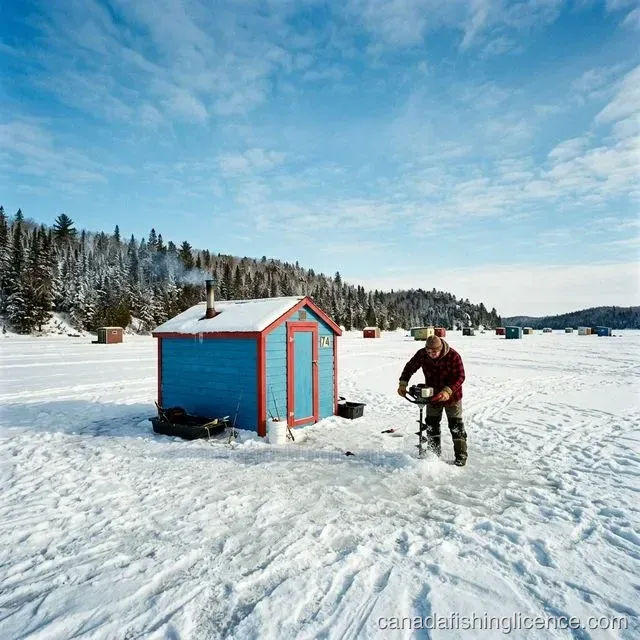
Where to set up: For your first trip, it can help to set up near, but not beside, other anglers. A distance of 20–30 metres is usually more respectful than crowding an existing hole. Local anglers may share depth or bait information, but treat that as a clue, not a rule.
Drilling the hole: A 6-inch hole is common for panfish; 8–10 inches is more common for larger fish such as walleye or pike. Clear the ice shavings from the hole with a skimmer before dropping the line.
How many holes? Start with 2–3 holes, spaced about 2 metres apart. In Ontario, most waters allow 2 ice fishing lines if you stay within 60 metres of every line or tip-up and keep a clear, unobstructed view. In Alberta, the general rule allows no more than 2 lines through ice-covered water and requires you to stay within 30 metres of any line. Check your province's regulations because local exceptions can change the answer.
Set your depth: Drop your jig to the bottom; you should feel a slight thud when it hits. Then reel up 6–12 inches (15–30 cm). Many bottom-feeding species, including perch and walleye, are often caught just off bottom. For trout, suspended mid-water can be worth trying. If a local shop or outfitter suggested a depth, start there and adjust.
Your seat: An empty 5-gallon bucket can work as a seat, gear storage, and fish container in one. Many experienced ice anglers still use buckets because they are light and simple.
Fishing — What It Actually Looks and Feels Like
Here's what your first hour actually looks like:
You are sitting on a bucket or compact chair, holding a short rod, and watching a spring bobber or rod tip. Your jig might be a few inches off bottom, tipped with legal bait or a small plastic. You jig with small wrist movements, pause, watch the line, and repeat.
Then — a subtle tap. The rod tip dips slightly, just a fraction of an inch. That's it. Ice fishing bites are gentle compared to open-water fishing. Short rod, small jig, cold sluggish fish, taut line. Set the hook with a quick upward wrist snap — not a dramatic arm swing, just a firm pop. Reel the fish up smoothly. Don't horse it — light line and a short rod mean you need to be patient.
At the hole, a small perch, sunfish, or other legal winter species may appear in the slush. Your first ice-caught fish might not be large, and some first trips end without a fish. The point of the first day is learning the routine: staying warm, reading the rod tip, keeping the line legal, and knowing when to move or pack up.
Common beginner targets: Yellow perch are a common winter target on many lakes. Bluegill/sunfish can be a good panfish target where open and legal. Crappie often school and may bite around low light. Walleye are popular, but they usually require more attention to timing, depth, and local rules. Match the bait or lure to the species and the legal bait rules for the water.
If nothing bites after 30 minutes: Change depth, change jig colour, move to a different hole, or ask nearby anglers what has been working. Ice fishing often has quiet stretches, especially for beginners. Fish move under the ice, and a slow hour does not always mean the whole day is finished.
Staying Warm — The Real Challenge
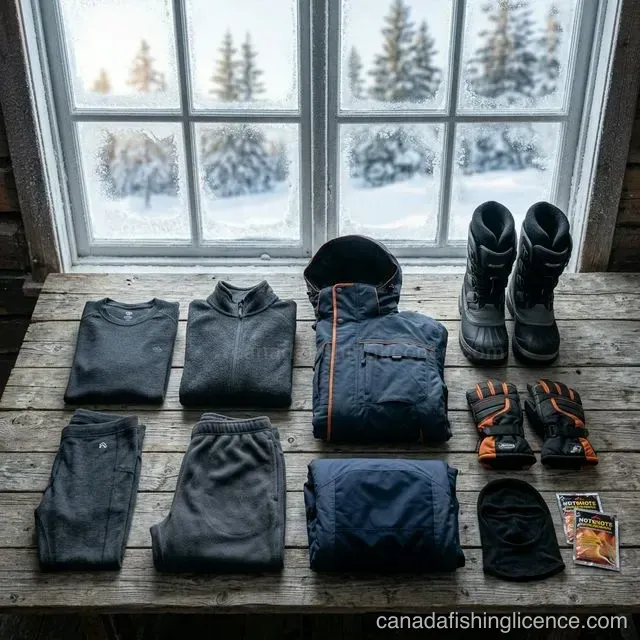
Cold is the #1 reason first-timers quit early. Here's how to stay comfortable for a full day on the ice:
Feet first. Cold feet end ice fishing days early. Wear insulated, waterproof boots suited to the forecast and the amount of standing or sitting you expect. Wear moisture-wicking socks, avoid cotton, and bring a spare pair in a dry bag.
Hands. Bring two pairs of gloves: thin liner gloves for handling bait and re-rigging (you need dexterity for tying knots and threading worms), and heavy insulated mitts for sitting and waiting between bites. Switch between them. Drop a hand warmer inside each heavy mitt — this makes a noticeable difference. Keep the heavy mitts inside your jacket between uses so they stay warm and dry.
Head and face. A balaclava or buff covers your face when the wind picks up. Wear a warm toque over it. The "40% of heat loss through the head" statistic is debatable but the practical reality is undeniable: an exposed head and face in -15°C wind feels brutal, a covered head feels manageable. Protect your ears specifically — frostbite hits ears and nose first.
The bucket trick. Put a foam sitting pad or piece of closed-cell foam on your bucket seat. A simple foam barrier reduces heat loss through the seat.
Emergency warmth. If you start shivering and cannot warm up with movement, take a warm-up break or head to the car. Hypothermia can impair judgment. If your fingers lose dexterity and you cannot tie a knot, it is time to stop or warm up.
Ice huts and shelters: You do not need a shelter for your first trip, but wind protection can make the day much more comfortable. Rentals are common on popular lakes. In Ontario, ice hut registration applies in FMZs 9–12 and 14–20 for non-fabric huts and larger fabric tents, and the registration number must be displayed outside at least 6.3 cm high. In Alberta, shelters left on the ice for more than 24 hours must show a WiN number or name and phone number in block letters at least 2.5 cm high.
Ice Hut Removal Deadlines — Don't Get Fined
If you rent a hut for the day, the outfitter usually handles registration and removal. If you own or leave a shelter on the ice, the deadline becomes your responsibility.
Ontario: registration applies in FMZs 9–12 and 14–20 for non-fabric huts and larger fabric tents. Removal dates are March 1, March 15, or March 31 depending on the FMZ, and all huts must come off before ice breakup.
Alberta: shelters left on the ice for more than 24 hours need a visible WiN number or name and phone number. Alberta says shelters must be removed by March 15 in PP1 and by March 31 in PP2, ES1–ES4, and NB1–NB4, or earlier if an officer directs removal.
For a province-specific hut check, see the Ice Hut Checker.
When to Call It a Day
A typical ice fishing day runs 4–6 hours for beginners. There's no shame in going home early — especially on your first trip. Good reasons to pack up:
You're cold and can't warm up. Safety first. Driving home while shivering and uncomfortable is no fun. A 3-hour trip where you catch fish and enjoy yourself beats a 6-hour endurance test. Most experienced anglers bring a change of warm, dry clothes in the car for the drive home.
The bite window closed. Fish are often most active in the first 2–3 hours after sunrise and late afternoon before sunset. The midday lull is real — many experienced anglers break for lunch in the car or at a nearby restaurant and come back for the "evening bite" in a separate session.
Weather turns. If wind picks up significantly, visibility drops (blowing snow), or temperature drops beyond what your gear can handle, pack up. Ice fishing in a whiteout is genuinely dangerous — you can lose your sense of direction on a featureless frozen lake. Mark your path with sticks or a GPS pin before heading out.
Packing up: Reel in your lines, pack your gear into the bucket, collect ALL garbage — including cut bait, line clippings, coffee cups, and worm containers. Leave nothing on the ice. Some lakes check for debris in spring when ice melts and communities track offenders. Pour hot water in your holes to melt the rim and make them visible to snowmobilers and kids exploring the lake, or mark with a branch if near a trail. Walk the same route you came out on.
The drive home: Warm up, swap into dry socks, and make a few notes while the trip is fresh: where you parked, what depth you tried, what bait or lure was legal and useful, and what you would pack differently next time.
Budget Snapshot for a First Trip
Here is a realistic cost breakdown for a first-time ice fishing trip, assuming you own winter clothes and borrow major gear:
Resident or short-term licence scenario: Some resident, youth, senior, or short-term licence paths can keep the licence portion modest, but non-resident and annual products can cost much more. Check current licence costs before using a budget number.
Must-buy: Licence or permit, legal local bait or lures ($5–$10), ice picks ($5–$10), hand warmers ($2–$4), and a skimmer ($3–$5). A resident or short-term trip with borrowed major gear can sometimes stay under $75; a non-resident annual licence or hut rental can push the total higher.
If renting gear: Rod, auger, and tackle rental from a local shop ($20–$40/day). This is a great option for testing the waters (literally) before investing. Many shops near popular lakes like Simcoe, Bay of Quinte, or Pigeon Lake offer all-inclusive rental packages.
If renting a heated hut: $50–$100/day is a common range for a basic outfitter hut experience on some popular lakes. Inclusions vary, so check whether holes, bait, chairs, and a heater are included.
If buying your own minimal setup: A basic ice fishing rod ($15–$30), hand auger ($50–$80), small tackle box with assorted jigs ($10–$15), bucket ($5), foam pad ($3). Total all-in: $83–$133 — and this gear lasts for years.
Either way, ice fishing can be a low-cost winter activity if you borrow or rent the expensive items first. For more on licence costs specifically, see the cost by province page.