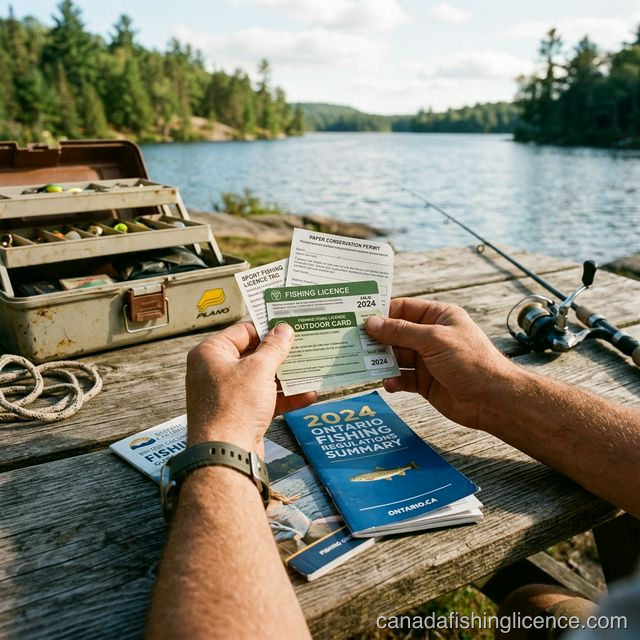
Canada does not have a single national fishing licence. Instead, 13 provinces and territories each run their own licensing system with different categories, prices, residency rules, and prerequisites. Layer on top of that a separate federal system for tidal (saltwater) waters managed by Fisheries and Oceans Canada (DFO), plus a Parks Canada permit required for fishing in any national park — and you have well over 100 possible licence combinations.
The quiz above walks you through the six decisions that matter most: where you're fishing, who you are (residency), how long your trip is, whether you're on freshwater or saltwater, whether you're targeting salmon (which often requires an additional stamp), and whether you'll be inside a national park. The result gives you a specific recommendation, an estimated price range, a list of prerequisite cards or registrations, and a direct link to the official purchase portal.
This is not legal advice, and the final check still belongs on the official portal. What this quiz does well is narrow the right permit path before you buy.
What the Quiz Covers — And What It Cannot
Covered by the Quiz
All 13 provinces and territories: Each jurisdiction is listed individually — no "Atlantic Provinces" or "Territories" catch-all grouping that sends you to the wrong page.
Three residency tiers: Provincial resident, Canadian non-resident, and international visitor (non-resident alien).
Freshwater, tidal (saltwater), and combination fishing: Including BC's dual-licence system where freshwater and tidal trips use different issuing bodies.
Salmon-specific requirements: The quiz flags when you need a separate salmon licence or conservation stamp.
National park permits: Recommends the Parks Canada permit when applicable.
Prerequisite cards and registrations: Ontario's Outdoors Card, Alberta's WiN, B.C.'s FWID, and Saskatchewan's Fisheries Habitat Certificate.
Not Covered by the Quiz
Indigenous fishing rights: First Nations, Métis, and Inuit peoples may hold treaty-based fishing rights that operate outside the provincial licensing framework. Contact your band office or the relevant co-management board.
Commercial fishing licences: This quiz is for recreational sport fishing only.
Competitive fishing tournament permits: Some provinces require separate event permits for organized fishing derbies.
Zone-specific or waterbody-specific closures: Individual rivers, lakes, or zones may have seasonal closures or special regulations. Always check the provincial regulation guide for your specific destination.
Charter-specific arrangements: Some charter boats operate under guide licences that may cover their clients. Verify directly with your charter operator.
The 6 Decision Points That Determine Your Licence
Every fishing licence decision in Canada comes down to six factors. The quiz asks one question for each. Here is why each one matters:
Province or Territory (Question 1): This is the single most important factor. Each of the 13 jurisdictions sets its own licence types, prices, age exemptions, and online purchase systems. An Ontario licence is not valid in Quebec. A BC freshwater licence is not valid in Alberta. Start with the place where you will fish, not where you live. Learn more on the federal vs. provincial licensing page.
Residency Status (Question 2): Non-resident prices are usually higher than resident prices, and the gap can be large. But "resident" means you live in that specific province. An Ontario resident fishing in BC pays BC's Canadian non-resident rate, not the BC resident rate. See the non-resident licences guide for detailed tier definitions.
Trip Duration (Question 3): Most provinces offer short-term options: 1-day, 3-day, 7-day, and 8-day licences, plus annual. The break-even point varies, but in many provinces the annual licence costs less than three 1-day licences. Use the Cost Calculator to compare.
Water Type (Question 4): In BC, freshwater and tidal (saltwater) fishing use different issuing paths. The province manages freshwater via the WILD system. DFO manages tidal via the NRLS portal. If you plan to fish both, plan for both paths. Atlantic coast trips should be checked on the province or species page rather than treated like the BC tidal system. See the BC tidal fishing guide.
Target Species (Question 5): General species (bass, walleye, pike, perch) are covered by the standard licence in many ordinary trips. Salmon carries additional requirements in multiple provinces. In BC, freshwater salmon retention uses a provincial non-tidal surcharge, while tidal salmon retention uses the federal $7.39 Salmon Conservation Stamp. Quebec Atlantic salmon trips use the salmon licence family. See the salmon licence guide.
National Parks (Question 6): Your provincial licence is not valid inside national parks. You need a separate Parks Canada fishing permit, and the exact permit scope should be checked on the park page for your destination. See the Banff fishing permit guide.
National Parks Use a Separate Permit
National park waters do not follow the same permit path as nearby provincial waters. That is why park trips need a separate check before you buy.
Parks Canada Permit Costs (2026)
Daily permit: $15.00 per person per day in the Rocky Mountain parks
Annual permit: $51.25 per person in the Rocky Mountain parks
Check the specific park page before you buy, because annual permit scope can vary by park or park group
Anglers under 16 may fish without their own permit when accompanied by a permit holder who is 16 or older
Available at park visitor centres, gate offices, or online at reservation.pc.gc.ca
Key distinction: A park entry pass is not the same thing as a fishing permit. Provincial free fishing weekends also do not waive the national park fishing permit requirement.
Do You Also Need a Provincial Licence?
Inside park waters, start with the Parks Canada permit and the specific park rules. If the same trip also includes nearby provincial waters outside the park boundary, keep the provincial licence in the plan as well.
Real Scenarios: What the Quiz Recommends and Why
Here are four real-world scenarios showing how the quiz's logic translates into specific licence recommendations and costs:
Scenario A: American Tourist — 5 Days in BC, Adds a Tidal Salmon Day
BC Freshwater Non-Canadian 8-Day Licence: $57.14
FWID Registration: Free through the BC WILD login path
DFO Tidal Waters 5-Day Licence: $38.18
Tidal Salmon Conservation Stamp: $7.39
Estimated total: $102.71 before applicable tax/GST
This visitor needs freshwater setup through WILD and a separate DFO tidal purchase for the ocean day. A freshwater salmon-retention trip would use the provincial non-tidal surcharge instead.
Outdoors Card: $8.57 (valid 3 years — may already own one)
Conservation Fishing Licence (annual): $15.07
Estimated total: $15.07–$23.64 + HST
The quiz recommends Conservation over Sport since this angler practises catch-and-release — saving ~43% ($11.50) compared to the Sport licence. Sport becomes worthwhile only if you regularly keep fish near the daily limit.
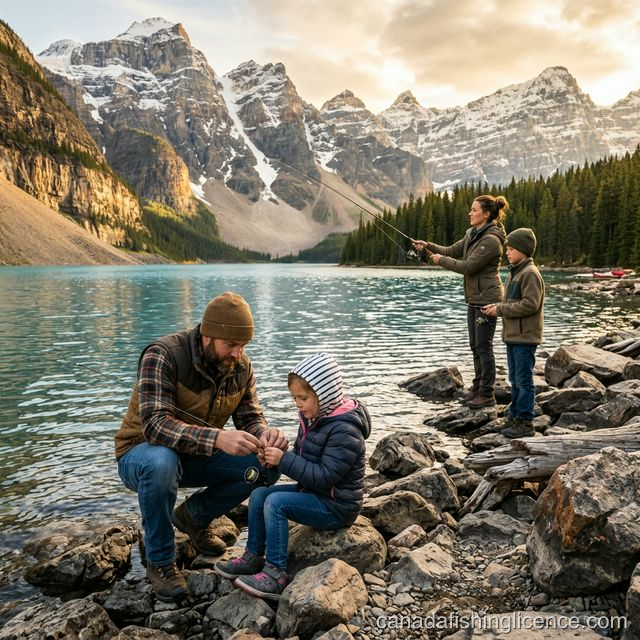
Scenario C: Alberta Family — 2 Adults, 2 Kids Under 14
2 × WiN setup: AlbertaRELM shows the current amount during account setup; skip this step if already active
Children under 16: Free — no licence required in Alberta
Estimated licence total: $60.00 + GST, plus any WiN setup shown by AlbertaRELM
Kids fish free under a licensed adult's supervision, but their catch counts toward the adult's daily limit unless they get their own licence.
Scenario D: Quebec Non-Resident — 3-Day Bass Trip
Quebec 3-Day Non-Resident Fishing Licence: $38.36
No prerequisite card required in Quebec
No salmon stamp needed (targeting bass)
Estimated total: $38.36 (taxes included in Quebec prices)
Quebec is one of the simpler provinces for visitors: no prerequisite card, taxes already included in the listed price, and eligible licences are available through My Hunting and Fishing Account.
2026 Changes That Affect Your Licence Choice
Two significant regulatory changes take effect in 2026 that the quiz accounts for:
British Columbia: WILD system launch on April 1, 2026
BC's WILD system replaces the old Freshwater Fishing E-Licensing system for 2026-27 freshwater purchases. Start at the BC WILD login page, set up a free Fish and Wildlife ID (FWID), and use Basic BCeID or an eligible BC Services Card Account for the online path. See the BC WILD transition guide for step-by-step instructions.
Saskatchewan: Fisheries Habitat Certificate for 2026-27
Saskatchewan now includes a Fisheries Habitat Certificate in many angling purchases — $21 annual or $5.25 short-term. This applies to anglers aged 16–64 unless an exemption applies. Youth under 16 and Saskatchewan residents 65+ are exempt. Revenue funds fish habitat conservation projects. If you also hold a Saskatchewan hunting licence, only one certificate is needed for both annual hunting and annual angling.
Licence year dates: Most provinces run their licence year from April 1 to March 31. Ontario is the exception — it uses the calendar year (January 1 – December 31). If you're buying a licence in early spring, make sure you're purchasing for the correct licence year.
After the Quiz: Step-by-Step Purchase Guide
Once you know which licence you need, follow these four steps to purchase it:
Go to the Official Provincial Portal: Always use the government or authorized portal — never third-party sites that charge markups. The quiz result includes a direct link to the correct portal for your province.
Select the Correct Licence Type and Duration: Choose your residency status carefully. Selecting "resident" when you are a non-resident is a regulatory offence. Where a province offers a reduced-harvest option, such as Ontario Conservation, choose it only if it matches how you plan to fish.
Carry Proof While Fishing: Most provinces accept a digital copy on your phone, but some require the printed licence summary. In BC under the new WILD system, your FWID + photo ID serves as proof for basic freshwater — but specialty stamps still require a paper or digital copy.
These five mistakes are worth checking before checkout because they can lead to fines, cancelled plans, or a licence that does not match the water you actually fish:
Buying "Resident" when you are a Non-Resident: This is one of the most expensive mistakes. Provinces can ask for proof of residency, such as a provincial driver's licence, health card, or other accepted document. Being a Canadian citizen is not the same as being a provincial resident. An Ontario resident fishing in BC pays BC's Canadian non-resident rate — not the BC resident rate.
Forgetting the Salmon Add-On or Separate Salmon Licence: A standard fishing licence does not always give you the right to retain salmon in B.C. or Quebec. B.C. freshwater and tidal waters use different salmon add-ons, while Quebec uses a separate Atlantic salmon licence family. Check the salmon product before you keep fish.
Fishing in a National Park without the Parks Canada Permit: Your provincial licence has no legal standing inside a national park. You need the separate Parks Canada fishing permit. The park fees page is the right place to confirm the current permit price before you go.
Using an Expired Licence from the Previous Year: Most provinces run their licence year April 1 – March 31. Ontario uses January 1 – December 31. If you purchase a licence in March, double-check whether it covers the current or upcoming season. An April fishing trip on a licence that expired March 31 is an offence.
Assuming One Licence Covers All Provinces: There is no Canada-wide fishing licence. If your road trip crosses provincial borders, you need a new licence for each province you fish in.
Before you fish: Carry the licence proof, stamp, card, or permit that matches the water and species. If you want to understand common fine examples by province, check the Fine Calculator before the trip.
Quiz Questions Summary
This interactive quiz helps determine which Canadian fishing licence you need by asking 6 questions:
Where do you plan to fish? — Options: Ontario, British Columbia, Alberta, Quebec, Saskatchewan, Manitoba, Nova Scotia, New Brunswick, Newfoundland & Labrador, PEI, Yukon, NWT, Nunavut
What is your residency status? — Options: Provincial resident, Canadian non-resident, International visitor
How long do you plan to fish? — Options: 1 day, 3–8 days, Annual
What type of water? — Options: Freshwater, Saltwater/Tidal, Both
Targeting specific species? — Options: General fishing, Salmon, Not sure
Fishing in a National Park? — Options: Yes, No, Not sure
Frequently Asked Questions
Is the quiz result legally binding? Can I use it as my licence?
No. This quiz is an educational tool that suggests a licence path based on your inputs. It is not a government-issued licence. Buy the actual licence through the official provincial, territorial, federal, or park portal listed in your result, and confirm the current rules there before checkout.
What if I'm fishing inside a National Park like Banff or Jasper?
You need a separate Parks Canada fishing permit for waters inside the park. Parks Canada says anglers under 16 may fish without their own permit when accompanied by a permit holder who is 16 or older, with the catch counted toward that permit holder. Permit prices are posted on each park's fees page. In the Rocky Mountain parks, the current listed rates are $15.00 daily and $51.25 annual. If the trip also includes waters outside the park, keep the provincial licence in the plan too.
Can I use one licence in multiple provinces?
No. Canada does not have one shared provincial fishing licence. Each province and territory manages its own fisheries independently. If your road trip crosses from Ontario into Quebec, you need the Quebec licence or exemption as soon as you fish in Quebec waters. B.C. tidal waters use a separate federal DFO tidal licence path.
Do I need a licence for catch and release?
Usually yes for adult recreational angling, but the exact rule depends on the province, water, species, age, residency, and free-fishing event. Catch-and-release still counts as angling in most ordinary licence systems, so check the local rule before assuming an exemption applies.
My situation isn't covered by the quiz options. What should I do?
The quiz covers the most common scenarios. For edge cases — such as Indigenous fishing rights, competitive fishing tournament permits, commercial fishing licences, or fishing on First Nations reserves — contact the provincial Fish & Wildlife agency directly. The province-specific pages include direct contact information and links to the relevant regulatory bodies.
How accurate are the prices shown in the quiz results?
The prices are practical estimates based on 2026 base fees and may exclude tax, checkout fees, portal charges, or species-specific add-ons such as BC non-tidal salmon surcharges or the tidal salmon stamp. Confirm the final cost on the official purchase portal before checkout.
Do charter boats or fishing guides provide the licence for me?
It depends on the province, water, species, and operator. Some guided or charter situations have special rules, but many trips still require each angler to hold the correct recreational licence or permit. Ask the operator which documents you personally need before the trip.
What happens if I buy the wrong licence type, such as resident instead of non-resident?
Treat the residency choice carefully. Provinces can ask for proof of residency, and the wrong class can lead to fines or other enforcement problems. If you notice the mistake before the trip, contact the issuing agency before you fish.
Last updated: August 2026. Licence types and requirements can change by jurisdiction. Check the official portal for current pricing, taxes, and add-ons before you buy.
Share the province, water type, and trip length if you know them. If you are still unsure, send the basic details and I will point you toward the next official check for that trip.
Thank you
Your message has been sent. I will read it and reply when a response is needed.
Optional analytics cookies help improve this site. See our
Privacy Policy.