| Ontario example | Resident 1-year fee | Why anglers choose it |
|---|---|---|
| Conservation | $15.07 | Lower cost, reduced harvest, often a good fit for lighter-keep or mostly release trips. |
| Sport | $26.57 | Fuller harvest option for anglers who want the regular limit structure where available. |
Which Fishing Licence Type Do You Need?
Most anglers in Canada start with a provincial or territorial freshwater licence. The licence type changes when the trip is in B.C. tidal water, inside a national park, for Atlantic or Pacific salmon, or in a province that separates harvest levels such as Ontario Sport and Conservation.
Before you buy, sort the trip in this order:
1. Is the trip on ordinary inland water, B.C. tidal water, or inside a national park?
2. Do you need the full harvest option or a reduced-harvest option such as Ontario’s Conservation licence?
3. Is the trip annual or short-term?
4. Which residency class applies to you?
5. Does the fishery add another layer such as a salmon licence, a conservation surcharge stamp, a classified-water licence, or Saskatchewan’s Fisheries Habitat Certificate?
If you already know the province, check the province page for prices. If you are still choosing between freshwater, tidal, salmon, park, non-resident, or harvest-tier rules, sort that licence type first. The licence types hub is the shorter route into the three main trip-specific type pages.
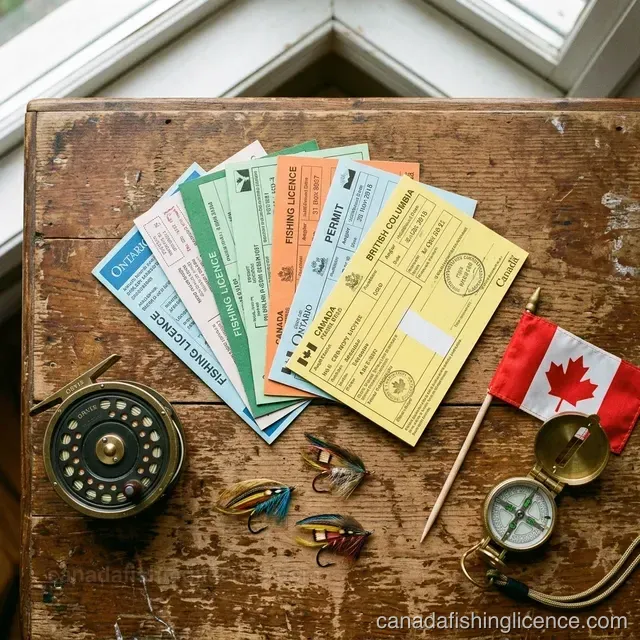
Type 1: The Ordinary Provincial Or Territorial Freshwater Licence
This is the licence most readers are actually looking for. If you are fishing an ordinary inland lake or river, the base licence normally comes from the province or territory where the water is located.
That licence is the main foundation for most recreational trips in Ontario, British Columbia freshwater, Alberta, Saskatchewan, Manitoba, Quebec inland waters, and the Atlantic provinces. It is also the starting point for many boat, ice, family, and shore-fishing trips.
The key point is that this type is tied to the water, not to your home base or your travel route. A road trip across more than one province can still require more than one freshwater licence.
Type 2: Harvest-Tier Licences Such As Ontario Sport And Conservation
Some systems do not only ask how long you want to fish. They also ask how much harvest flexibility you want.
Ontario is the clearest example. The province sells Sport and Conservation fishing licences. Sport is the fuller harvest option. Conservation is the lower-cost option with reduced catch and possession limits.
That makes Ontario one of the few places where “licence type” directly changes the harvest limits in a way many readers feel on the water. If you are mostly catch-and-release fishing or only keeping a very small amount, Conservation can make sense. If you want the province’s full regular limits where available, Sport is the stronger fit.
Not every province uses these same labels, which is why Ontario’s Sport-versus-Conservation split should be treated as a province-specific type question rather than a national standard.
Type 3: Short-Term And Annual Licences
Many systems also divide licences by duration. This is one of the most practical type decisions because it directly affects what you pay.
Ontario offers a one-day sport option for short visits. Quebec’s general sport-fishing system lists 1-day, 3-day, 7-day, and annual options for non-residents. DFO’s B.C. tidal system lists 1-day, 3-day, 5-day, and annual options. Those are all examples of the same idea: choose the duration that matches the trip instead of defaulting to annual just because it sounds simpler.
This is especially important late in the licence cycle. A short trip near season end can sometimes fit a short-term licence better than an annual purchase.
Type 4: Residency Classes
Canadian licence types are also divided by who you are in relation to the province or country. The exact language varies, but anglers usually run into some version of these classes:
| Residency class | What it usually means |
|---|---|
| Resident | You meet that province or territory’s residency standard. |
| Canadian resident | You live in Canada, but not in the province selling the licence. |
| Non-Canadian resident or non-resident alien | You live outside Canada and are visiting as an international angler. |
This type question matters because the same trip can produce a different licence menu and different price points depending on which residency class applies to you.
Type 5: Separate Tidal And Park Permit Systems
Some Canadian fisheries are not just another version of the freshwater licence. They are separate systems.
B.C. tidal waters: Fisheries and Oceans Canada manages the B.C. Tidal Waters Sport Fishing Licence separately from provincial freshwater licensing. If the trip is in tidal water, use that system instead of assuming the provincial freshwater licence covers it.
National parks: Parks Canada says a national park fishing permit is required when angling in national parks in Canada, and provincial licences are not valid there.
These are true type changes, not just add-ons. Once the water falls into one of those systems, the base licence path itself changes.
Type 6: Add-On Licences, Stamps, And Certificates
Some trips keep the same base licence but add another layer on top. This is where many readers start using “type” to mean “extra document,” and that is often reasonable.
B.C. conservation surcharge and classified-water layer: B.C. freshwater anglers can need more than the base licence on certain trips, especially where classified waters or conservation surcharge stamps apply.
Quebec salmon: Quebec uses a separate salmon licence path for salmon fishing rather than treating salmon as just another ordinary inland licence choice.
Saskatchewan: beginning with the 2026-27 season, many Saskatchewan anglers also need the new Fisheries Habitat Certificate alongside the licence purchase.
The practical way to read this is simple: a base licence gets you into the system, but the fishery may still add an extra layer before the trip is legally complete.
Youth, Senior, And Similar Exempt Or Reduced-Requirement Paths
Some licence “types” are really better understood as reduced-requirement or exempt pathways rather than ordinary paid categories.
Ontario is a useful example. The province says Canadian residents under 18 and seniors 65 and over can fish without needing to buy a licence, subject to the rules that apply to those groups. Parks Canada separately says anglers under 16 do not need their own permit if accompanied by a permit holder aged 16 or older, but their catch counts toward that adult’s daily limit.
Other provinces use their own youth, senior, veteran, or reduced-fee structures. The main habit that helps here is not to assume that one province’s exemption carries into another. For the broader age picture, use Fishing Licence Age Requirements alongside the province page.
What Is Not A Fishing Licence Type
A lot of confusion comes from paperwork that is real, but not actually a fishing licence.
Boating competency: a Pleasure Craft Operator Card is a Transport Canada boating requirement for operating many motorized pleasure craft. It is not a fishing licence. If the boat operator needs that proof, the PCOC boating card guide is the better next step.
Boat identification: a Pleasure Craft Licence is a boat-identification document. It is not a fishing licence either.
Guide or charter booking: paying a guide, charter, lodge, or outfitter does not turn the operator’s paperwork into your own recreational fishing licence if the fishery requires one from the angler.
Owner permission on private land: permission to access a pond or shoreline is also not the same thing as a fishing licence where provincial or federal rules still apply.
A Simple Way To Pick The Right Type
For a short decision path, follow this order every time:
| Step | Question |
|---|---|
| 1 | What exact water am I fishing? |
| 2 | Is it ordinary inland water, B.C. tidal water, or a national park fishery? |
| 3 | What residency class applies to me? |
| 4 | Do I want a short-term or annual option, and if relevant a reduced-harvest or full-harvest option? |
| 5 | Does the fishery add salmon, classified-water, surcharge, or certificate requirements? |
Once those five questions are answered, most Canadian licence types become much less confusing.