Speed Is Everything
One of the most important factors in catch-and-release survival is how fast you get the fish back in the water, especially in warm water or after a long fight. A fish that stays wet and is released quickly usually does better than one kept out of water while you search for tools or force a difficult hook.
The golden rule: if you can't get the hook out in 15 seconds, cut the line. In many cases, a fish does better with the hook left in place than with a long struggle near the throat or gills.
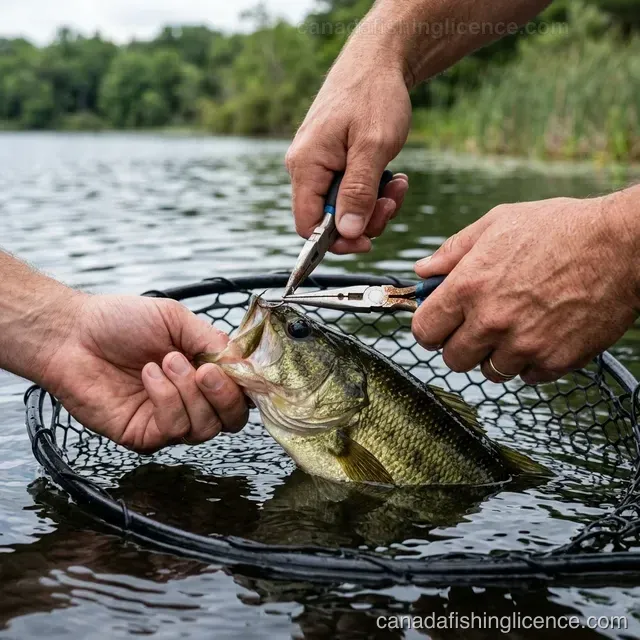
Before You Start — Preparation Makes It Easy
Have your tools ready before you hook a fish. The worst time to search your tackle box for pliers is when a fish is flopping on the dock.
Essential tools: Needle-nose pliers or forceps (hemostats). These are $5-$10 at any tackle shop. Attach them to your vest, belt loop, or tackle box with a lanyard. Having them within arm's reach is the difference between a 10-second release and a 60-second struggle.
Optional but very helpful: A rubber-mesh landing net (much gentler on fish than knotted nylon nets). A wet towel or wet gloves for handling (dry hands strip the fish's protective slime coat). A hook remover tool (a plastic T-shaped device that slides down the line and pops hooks free — excellent for deep hooks).
Wet your hands before touching any fish. Your dry hands remove the mucus layer that protects fish from infection and disease. A quick dip in the water takes one second.
Standard Hook Removal — The 10-Second Method
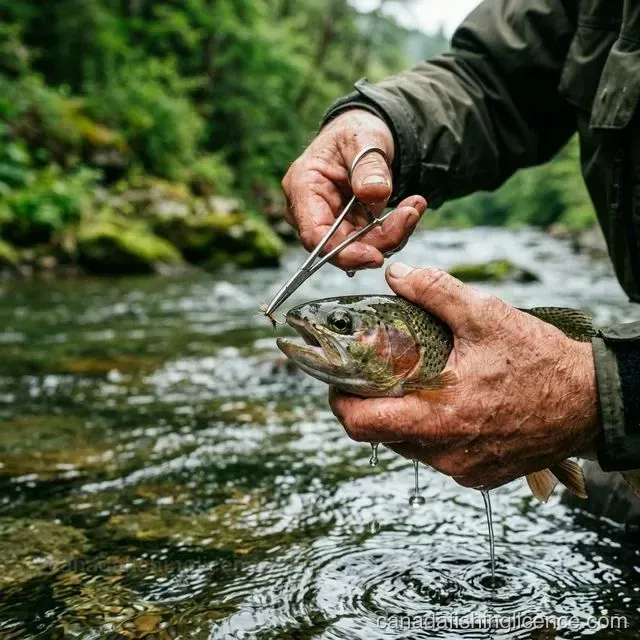
This is for fish hooked in the lip or corner of the mouth, which is where many properly caught fish end up.
Step 1: Keep the fish in or just above the water. If it's a small fish (under 30 cm), you can hold it gently but firmly with one wet hand around its body. If it's larger, keep it in the net in the water while you work.
Step 2: Grip the hook shank (the straight part, not the point) with your pliers.
Step 3: Rotate the hook back the way it went in — not straight out, but following the curve of the hook. A slight twisting motion while pulling back often pops it free.
Step 4: Release the fish into the water, facing into the current if you're in a river. Hold it gently until it swims away under its own power. Don't throw it.
Total time: 5-10 seconds for a lip-hooked fish. If you practice this once, it becomes easier to do calmly.
What to Do When the Hook Is Deep (the "Gut Hook")
A deep-hooked fish means the hook is in the throat, gills, or stomach. This usually happens when using live bait and the fish swallowed the bait before you set the hook. Here's the critical decision:
If the hook is visible and accessible (you can see it in the back of the mouth): Use long needle-nose pliers or a hook remover tool. Grip the hook shank and rotate it free. This works for throat hooks where you can still see metal.
If the hook is NOT visible or you can see it's near the gills: DO NOT try to pull it out. Pulling a hook through or near the gills can seriously injure the fish. Instead:
Cut the line as close to the hook as possible. Use scissors or line clippers to cut the line right at the hook eye. Push the remaining line into the fish's mouth so nothing trails out. Many fish have a better chance with the hook left in place than with a deep hook torn out through the throat or gills.
If the fish is bleeding from the gills: This is serious, and the fish may not survive regardless. If regulations allow and you are within your catch limit, keeping the fish may be the more practical choice.
Prevention: Set the hook sooner. When bait fishing, don't wait too long after a bite. A quick hook-set when the bobber first goes under usually hooks the fish in the lip, not the throat.
Barbless Hooks — Why They're Worth It
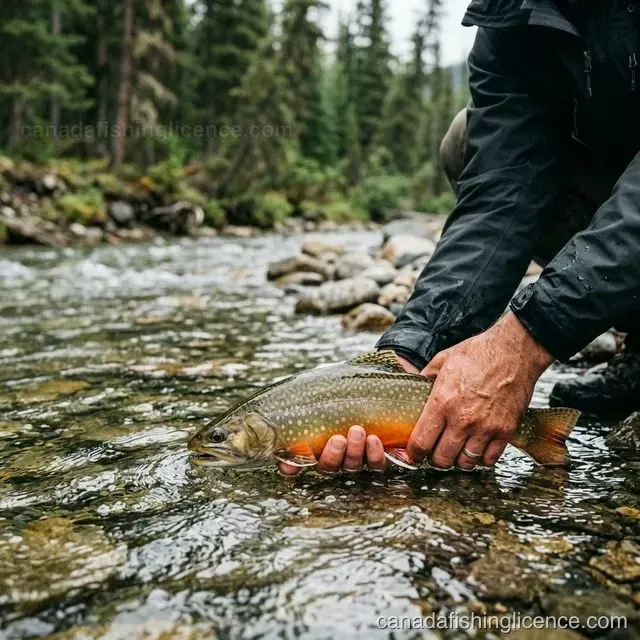
Barbless hooks are required by law in some Canadian waters — including some National Parks, some provincial waters, and special-regulation areas. Check the local rules before you fish. Even where they are not required, many anglers choose them because:
Removal is faster. Without the barb, the hook usually slides out with a gentle twist. That makes releases simpler on lip-hooked fish.
They are easier on the fish. Barbless hooks usually cause less tissue damage and less bleeding than barbed hooks.
You may lose a few more fish. That is the trade-off, especially while you are still adjusting your technique. Keep steady pressure and avoid giving slack.
How to make barbed hooks barbless: Pinch the barb flat with pliers. It only takes a moment. The hook still holds fish well — the barb isn't what keeps the hook in during a fight; that's the hook shape and your line tension.
Where barbless is mandatory: Rules vary by province and waterbody. When in doubt, go barbless where the rules are unclear.
Handling Fish Properly
Good hook removal means nothing if you damage the fish while handling it:
Wet your hands. Always. Every time. Dry hands strip the protective slime coat that prevents infection.
Don't squeeze. Support the fish; don't grip it. For small fish, cradle it loosely in one wet hand. For large fish in a net, work on the hook while the fish stays in the water.
Avoid touching the gills. Gills are the fish's lungs — damage to gills is often fatal. Never grab a fish by the gills or stick your fingers in the gill openings.
Minimize air time. Imagine holding your breath — that's what the fish is doing out of water. Aim for under 15 seconds of air exposure. If you want a photo, have the camera ready BEFORE you lift the fish.
The photo rule: "Camera ready, fish up, 3 seconds, fish back." Don't hold a fish in the air while your friend finds their phone, opens the camera app, and takes 6 photos. That kind of delay can turn a healthy release into a poor one.
Hold properly for photos: Support the belly with one hand, hold the tail area with the other. Never hold a fish vertically by the jaw — the weight of the body can damage the jaw structure. Hold horizontally, close to the water, and return immediately.
Different Hook Types and What to Know
Single hooks (standard): Easiest to remove. One point, one barb. The standard twist-back removal method works well.
Treble hooks (on lures): Three hooks in one — these are harder to remove because multiple points can embed. Use pliers carefully, removing one hook at a time. Some catch-and-release anglers replace treble hooks with single hooks.
Circle hooks: Designed to hook fish in the corner of the mouth, which makes removal easier and can reduce deep-hooking. Required for some species in some jurisdictions. If you bait fish for catch-and-release, circle hooks are worth trying.
Fly hooks: Usually barbless (often required) and single-pointed. Typically the easiest to remove — a gentle twist pops them free.