| 2026 salmon question | Nova Scotia answer |
|---|---|
| Can salmon be kept? | No. All salmon must be returned alive immediately; the daily catch and retain limit is 0. |
| What gear is allowed? | Only barbless artificial flies are permitted when fishing for salmon. |
| SFA 18 broad zone | Catch-and-release only, Sept. 1 to Oct. 31, with a daily release limit of 4 and named Margaree exceptions below. |
| SFA 19 broad zone | Closed all year except Baddeck River, Middle River, and part of North River; open sections have a daily release limit of 2. |
| SFA 20, SFA 21, and SFA 22 | Closed to Atlantic salmon fishing all year. |
Nova Scotia Atlantic Salmon Licence 2026
To fish for Atlantic salmon in Nova Scotia in fresh water, choose the salmon licence path. Nova Scotia treats salmon separately from the General Fishing Licence, and the salmon licence is valid only for salmon. For other freshwater species, follow the General Fishing Licence path instead.
For Atlantic salmon licence cost, catch log, SFA rule, season, gear rule, or catch-and-release planning, answer the salmon question before looking at the broader freshwater licence system.
The 2026 Nova Scotia salmon licence page lists the seasonal salmon licence as valid from June 1 to October 31, 2026. It lists $41.68 for residents age 18 and older, $156.08 for non-residents age 18 and older, $63.15 for a non-resident 7-day licence, and $29.79 for a one-day licence. Seasonal salmon licences are listed at no cost for residents and non-residents age 16 and 17, and for eligible residents and non-residents age 18+ with a disability.
You still need to check the current salmon regulations for the river, season, gear rules, and report-card requirements before fishing. If your trip is for trout, bass, stocked lakes, or other freshwater species instead of salmon, the Nova Scotia fishing licence price and Anglers Handbook guide is the better next step.
Why Nova Scotia Atlantic Salmon Gets Separate Rules
Atlantic salmon (Salmo salar) are anadromous fish — they are born in freshwater rivers, migrate to the North Atlantic Ocean to feed and grow, and return to the river of their birth to spawn. This life cycle makes each river population sensitive to habitat damage, fishing pressure, and ocean survival changes.
Nova Scotia has a long Atlantic salmon history, but river populations are not all in the same condition. Habitat, water temperature, fish passage, ocean survival, and river-specific management all matter, so the current salmon table should be checked by river.
Nova Scotia uses a careful recreational framework for Atlantic salmon. Salmon rules are handled separately from the standard General Fishing Licence, and current salmon regulations should be checked by SFA and named river before a trip.
The practical point is simple: do not treat salmon as a small add-on to a general trout or stocked-lake trip. Plan the salmon licence, river, date, gear, and catch log before you cast.
Salmon Licence Versus General Licence
Nova Scotia separates the freshwater licence path by species. The General Fishing Licence is for freshwater species other than salmon. The Salmon Fishing Licence is for Atlantic salmon in fresh water, and the provincial salmon page says it is not valid for any other species of fish.
That means the first question is the target species. If the trip is for stocked trout, bass, perch, or other non-salmon freshwater fish, follow the General Fishing Licence path. If the trip is for Atlantic salmon, choose the Salmon Fishing Licence path and then read the current salmon regulations for the river.
2026 Licence pricing (CAD):
• General Fishing Licence — Resident (18–64): $27.41 | Resident 65+: $6.74 | Non-Resident Annual: $34.55 | 1-Day: $13.04 for residents and non-residents age 18+
• Salmon Licence — Age 16–17 seasonal: no cost | Resident age 18+ seasonal: $41.68 | Non-Resident age 18+ seasonal: $156.08 | Non-Resident 7-Day: $63.15 | 1-Day: $29.79 for residents and non-residents age 18+ | Eligible disability seasonal licence: no cost
Practical sequence: Choose the licence path by species, then apply through the official Nova Scotia salmon fishing licence service. The licence is delivered as a PDF. Carry it while fishing, either printed or available on your phone.
Short-term option for visiting anglers: The 7-day Non-Resident Salmon Licence ($63.15) is the most practical entry point for anglers on a one-week Maritime trip. The 1-day option ($29.79) is available but requires careful timing if you intend to fish on multiple days — each day requires its own 1-day licence. For any trip longer than two salmon-fishing days, the 7-day option offers better value.
Visitor guide note: Unlike some guide-required waters in neighbouring New Brunswick, Nova Scotia does not have a broad non-resident guide requirement for every salmon trip. Non-residents still need the correct licences and current river rules. The Nova Scotia fishing licence page gives the broader province setup.
Gear Checklist: What to Check Before You Target Salmon
Nova Scotia's Atlantic salmon gear rules are strict. For salmon, the baseline is barbless artificial flies only. The checklist below keeps that rule separate from gear you might use on other freshwater trips.
Hooks — The Most Enforced Rule
Barbless artificial flies. Use barbless artificial flies for salmon. If a hook has a barb, flatten it fully before fishing.
Treble hooks. Do not use treble-hook gear when targeting salmon.
Bait and scented lures. Do not treat bait, scented soft plastics, or ordinary spin-fishing lures as a salmon setup. Keep them for other species trips only when the species rule allows them.
Landing Net
Recommended: Rubber-mesh or knotless soft-mesh landing net. A soft net helps keep the fish wet and reduces abrasion during release. While the specific net material is not codified in Nova Scotia's regulations, it is the better fit when the river rule requires release.
Additional recommended gear for compliant C&R:
• Needle-nose pliers or forceps for barbless hook removal without lifting the fish from the water
• Thermometer — avoid fishing during heat events where warm water can make handling more stressful for salmon
• Wet hands before touching fish — this is a simple way to reduce abrasion during hook removal
Your Catch Log: How to Fill It Out, When to Submit It, and Why It Matters
The Nova Scotia Salmon Licence comes with a catch logbook stub. Treat it as part of the licence paperwork, not a souvenir to ignore after the trip.
What the logbook records: Your logbook stub is designed to capture your salmon-fishing effort over the course of the season. For each salmon encounter, record the date, the river fished, and the outcome required by the licence instructions. Those records help fisheries staff understand salmon encounters, river use, and season timing.
How to fill out the logbook correctly:
Step 1. Record each salmon encounter on the date it occurs. Do not batch entries or fill out the log retroactively at the end of a trip — entries are intended to be contemporaneous records.
Step 2. Record the river name exactly as it appears in the current Anglers' Handbook. If you are unsure of the river's official name, note the county and the nearest geographic reference point.
Step 3. Record the number of salmon encountered and released according to the logbook instructions. If the licence asks for a zero-encounter or "nil" return, complete that too.
Step 4. Submit the Salmon Fishing Licence Report Card within 7 days of the end of the fishing season, even if you did not catch salmon or did not fish for salmon at all. Do not discard the licence paperwork until the return step is finished.
Why this matters beyond compliance: Salmon encounter records help managers understand river use and season timing. A complete logbook is a small task that supports better river-level decisions.
Atlantic Salmon Rivers in Nova Scotia: SFA Context and How to Find 2026 Season Information
Nova Scotia's Atlantic salmon fishery is managed on a river-by-river basis within Salmon Fishing Areas. Season dates, gear restrictions, and closures can vary by individual river, not only by the broad SFA line. A river that was open in an earlier season still needs a current-season check.
Do not plan a Nova Scotia salmon trip from last year's information or a third-party summary alone. River-specific salmon regulations for 2026 are published through Nova Scotia sportfishing resources and the current Anglers' Handbook, available from novascotia.ca/fish/. Read the current handbook before you choose a river or book travel.
SFA context for Atlantic salmon rivers: The 2026 salmon overview is catch-and-release only. SFA 18 is open Sept. 1 to Oct. 31 in the broad zone, with named Margaree exceptions and a daily release limit of 4. SFA 19 is closed all year except Baddeck River, Middle River, and part of North River, with a daily release limit of 2 on the open sections. SFA 20, SFA 21, and SFA 22 are closed all year.
• SFA 18 broad zone: Sept. 1 to Oct. 31, catch-and-release only, zero retain limit, daily release limit 4, barbless artificial flies only.
• Margaree waters in SFA 18: Margaree River, Northeast Margaree River, Southwest Margaree River and tributaries are open June 1 to Oct. 15; the upper Margaree stretch runs June 1 to Oct. 31; Northeast Margaree upstream from the Big Intervale bridges is closed all year.
• SFA 19 named waters: Baddeck River and Middle River are open Oct. 1 to Oct. 31; North River downstream from “The Benches” is open June 1 to July 14 and Sept. 1 to Oct. 31; North River upstream from “The Benches” is closed all year.
• SFA 20 to SFA 22: Closed to Atlantic salmon fishing all year.
Emergency and in-season closures: Specific rivers can close or change during the season when conditions change. Check for active closures close to your planned trip, not only at the start of the season.
Before you book your trip: Check Nova Scotia Inland Fisheries and the relevant DFO salmon notice for the current-season status of your specific river. Local fishing associations can help with water conditions and access, but the official rule still controls.
What a Conservation Officer Checks — and How to Be Ready
Conservation officers may inspect your licence, equipment, and logbook while you are fishing or immediately after. The safest preparation is simple: carry the right licence proof, keep the log current, and check the fly before fishing.
Licence inspection: Officers can ask to see the salmon licence and any other licence proof required for the trip. If you rely on a PDF, save it offline before heading to a river with weak service.
Hook inspection: Officers may inspect the hook setup. Carry forceps or needle-nose pliers and flatten barbs before you fish, then re-check after snags or hook changes.
Logbook inspection: Officers may ask to review your logbook entries for the current season. Entries that are clearly backdated, incomplete, or inconsistent with your location history can raise compliance questions. Maintain contemporaneous entries as a matter of habit.
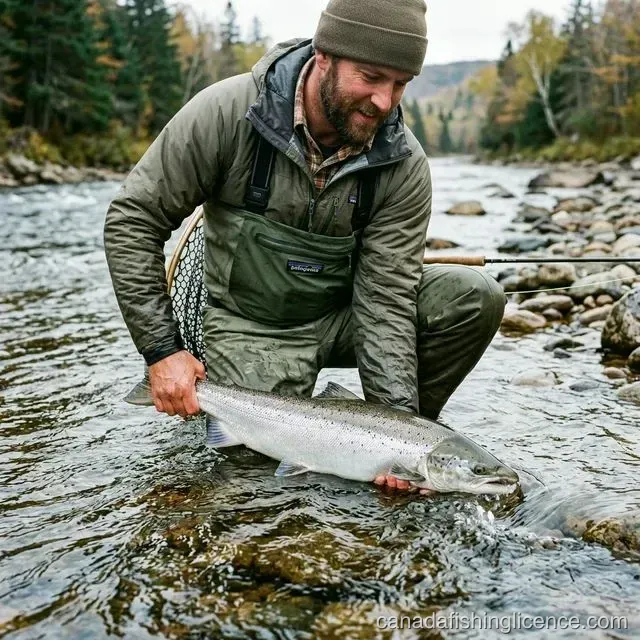
Fish handling observation: Officers may observe how quickly and carefully a salmon is released. Keep the fish wet, remove the hook efficiently, and avoid turning a required release into a photo session.
Violations related to Atlantic salmon may result in fines, licence consequences, or equipment seizure. Treat salmon rules as their own compliance check, separate from ordinary trout or smallmouth planning.
For a broader guide to interacting with conservation officers during any fishing inspection, see What to Do if a Conservation Officer Stops You.