| Trip type | Main rule path | What to check next |
|---|---|---|
| Inland trout or general freshwater | New Brunswick angling licence | Check the province page and the Fish Book for seasons, limits, and local exceptions. |
| Atlantic salmon inland trip | New Brunswick salmon licence | Check salmon rules and then confirm whether guide-required waters apply. |
| Pure tidal trip | Federal tidal rules | Check DFO recreational fisheries pages for the species and area. |
| Trip that starts inland and ends in tidal water | Both systems can matter on the same day | Work out the inland-water boundary first, then read the inland and tidal rules separately. |
New Brunswick Salmon and Tidal Rules Use Different Paths
New Brunswick is easier to understand when you separate three questions. First: are you fishing inland or tidal water? Second: are you targeting ordinary inland sport fish or Atlantic salmon? Third: if salmon is involved, are you also stepping into guide-required or other special-access waters?
This split matters when the New Brunswick question is Atlantic salmon, tidal water, an inland-water boundary, no provincial angling licence in tidal water, or federal tidal rules.
The broad rule is straightforward. A normal angling licence is for inland angling, but it does not authorize fishing for Atlantic salmon. If you are targeting Atlantic salmon, use the salmon licence path instead. New Brunswick also states that no provincial angling licence is required in tidal waters, which means the trip moves into the federal rule system for the species and area you plan to fish.
That combination is why New Brunswick can feel more complicated than it first appears. One day can begin on an inland trout river, continue into a tidal section, and involve salmon-specific restrictions that are separate from both the ordinary inland angling licence and the basic tidal no-licence rule. If guide-required water is involved, check the New Brunswick guide-required waters guide before you finalize the trip.
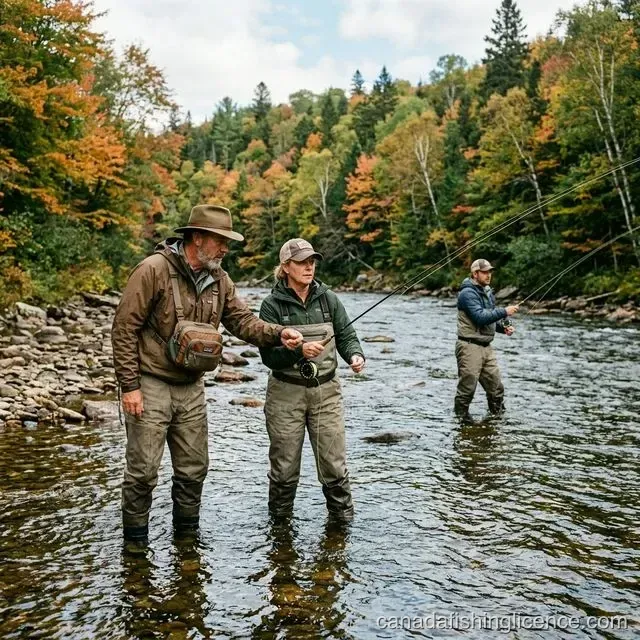
What A Normal New Brunswick Angling Licence Covers
For ordinary inland fishing, New Brunswick’s angling licence is the starting point. That is the path for common inland trips built around trout, bass, perch, or other freshwater sport fish that are not Atlantic salmon.
The important limit is the one the province states clearly in its Fish Book and licensing material: an angling licence does not authorize the holder to angle for Atlantic salmon. That line matters because many visitors assume a general inland licence is enough to begin fishing and then upgrade later if they decide to target salmon. In New Brunswick, that is the wrong order.
If Atlantic salmon is anywhere in the plan, settle the salmon side of the trip first. That includes the salmon licence itself and, for non-residents, the separate question of whether the river section falls under guide-required water rules.
What Changes When Atlantic Salmon Is The Target
Atlantic salmon sits in its own category. In New Brunswick, the province treats salmon fishing as something outside the normal angling-licence path, which is why there are separate salmon licence products and separate non-resident access checks.
For residents this mainly changes which licence to buy and which salmon rules to follow. For non-residents the effect is bigger, because a salmon trip can also activate the province’s guide-required waters rules on named waters during the main part of the season.
The practical lesson is that “salmon” should never be treated as a small add-on to a standard New Brunswick angling trip. It is its own planning branch, and it is worth sorting out before you commit to travel dates, a lodge, or a guide.
What New Brunswick Means By Tidal Waters
New Brunswick publishes a separate tidal-waters explanation because the boundary matters legally. The province defines tidal waters as waters downstream from the inland-water boundary where the tide ebbs and flows. Once your trip moves into that zone, the province says a New Brunswick angling licence is not required.
That does not mean the trip is unregulated. It means the rules are no longer coming from the ordinary inland angling licence system. Tidal trips move into the federal fisheries framework, so species rules, openings, closures, and limits need to be checked through the appropriate Fisheries and Oceans Canada pages for the region and species involved.
This is especially important in estuaries and lower-river trips where anglers can move across the inland-to-tidal boundary without feeling like they changed fisheries. In New Brunswick, that boundary can change which authority governs the day, which licence path applies, and which rules you need to read.
A Trip That Crosses Both Systems Needs A Clear Sequence
The easiest way to avoid mistakes is to name the trip type before you buy anything:
If the trip is built around common tidal species, the federal pages are usually the right next stop. For example, DFO’s Maritimes recreational fisheries pages list tidal-water species such as mackerel, pollock, flounder, and other finfish, and they note where a licence is or is not required under federal management.
Why Non-Residents Should Treat Salmon And Tidal Planning Separately
For non-residents, the inland-salmon question and the tidal-water question can look similar at first because both sit outside the simplest inland-angling workflow. In practice, they should be planned separately.
A non-resident salmon trip is mainly about the New Brunswick salmon licence, river access, and whether guide-required waters rules apply. A tidal trip is mainly about the federal species rules, openings, and closures that govern the area you plan to fish. Blending the two into one assumption is where mistakes happen.
A safe last check is simple: if the water is tidal, read the federal page for that species; if the target is Atlantic salmon, read the salmon licence and guide-required-water material; if the day could involve both, plan both before you go.